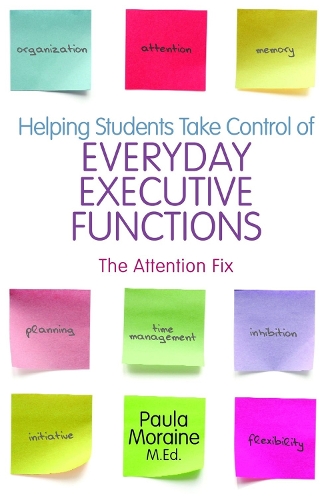
Student-centred approach to develop executive functions, including attention, memory, organization, and initiative
This book presents an innovative model for strengthening and developing executive function in any student, including those with attention, memory, organization, planning, inhibition, initiative, and flexibility difficulties. It provides guidance on how to support each student's evolving executive function, and how to encourage those who are ready to develop self-advocacy and become more responsible for the development of his or her own executive function skills.
The author advocates a student-centred approach in which educators first explore eight key 'ingredients' with the student: relationships; strengths and weaknesses; self-advocacy and responsibility; review and preview; motivation and incentive; synthesis and analysis; rhythm and routine; and practice and repetition. She provides step-by-step explanations of how the educator and student can then explore and use these 'ingredients' in different ways and in different combinations to successfully address particular areas of difficulty. The approach is clearly explained, and the author provides many useful examples, tried-and-tested practical tips and strategies; suggested conversation starters; sample time management plans; and other tools that can be adapted to meet the particular needs and abilities of each individual student.
Original and effective, the approach outlined in this book will be of interest to teachers and other professionals involved in supporting executive function in students of all ages, as well as parents and carers.
"
This book presents techniques to use with students, both in schools and at home. It is aimed at educators and, to some extent, parents. The author explores 'executive functions', which she defines as attention, memory, planning, organization inhibition, initiative, and flexibility... The book is also American and focuses on the United States school system. There are, however, many concepts, ideas, and interventions which are transferrable to the United Kingdom. Overall this is a useful book which
offers a model of working for those based in the education system and perhaps elsewhere.
" - British Journal of Occupational Therapy (BJOT)