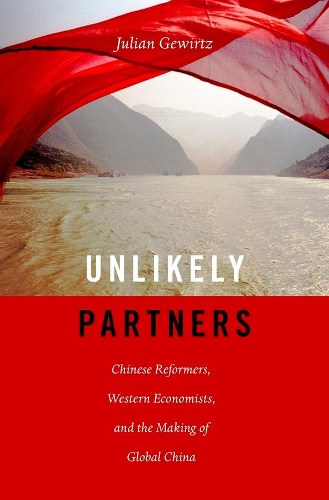
Книга Unlikely Partners: Chinese Reformers, Western Economists, and the Making of Global China
Unlikely Partners recounts the story of how Chinese politicians and intellectuals looked beyond their country’s borders for economic guidance at a key crossroads in the nation’s tumultuous twentieth century. Julian Gewirtz offers a dramatic tale of competition for influence between reformers and hardline conservatives during the Deng Xiaoping era, bringing to light China’s productive exchanges with the West.
When Mao Zedong died in 1976, his successors seized the opportunity to reassess the wisdom of China’s rigid commitment to Marxist doctrine. With Deng Xiaoping’s blessing, China’s economic gurus scoured the globe for fresh ideas that would put China on the path to domestic prosperity and ultimately global economic power. Leading foreign economists accepted invitations to visit China to share their expertise, while Chinese delegations traveled to the United States, Hungary, Great Britain, West Germany, Brazil, and other countries to examine new ideas. Chinese economists partnered with an array of brilliant thinkers, including Nobel Prize winners, World Bank officials, battle-scarred veterans of Eastern Europe’s economic struggles, and blunt-speaking free-market fundamentalists.
Nevertheless, the push from China’s senior leadership to implement economic reforms did not go unchallenged, nor has the Chinese government been eager to publicize its engagement with Western-style innovations. Even today, Chinese Communists decry dangerous Western influences and officially maintain that China’s economic reinvention was the Party’s achievement alone. Unlikely Partners sets forth the truer story, which has continuing relevance for China’s complex and far-reaching relationship with the West.
"Shedding light on how China achieved radical economic change in less than two decades, [Gewirtz’s] book is instructive for anyone who wants to know how other countries can emerge from poverty and place themselves on the path to development…At a time when the Chinese model again seems to be creaking, President Xi Jinping would be wise to heed the message of Gewirtz’s book: that China does best when it is open to foreign ideas." - Wall Street Journal
"A remarkable book, written with poise and confidence, that shows how closely Chinese reform was tied to ideas from the capitalist and socialist blocs during the Cold War, and illuminates the beginnings of an economic idea that would transform China and change the world." - Project Syndicate
"I loved this book. It is a tour de force on China, the theory of policy advising, and the history of economic thought, all rolled into one." - Marginal Revolution
"It vividly brings to life China’s economic debates from Mao’s death in 1976 until 1993, by which time the country’s direction was clearer… The claim is not that Westerners were responsible for China’s development. A large constellation of Chinese reformers deserves the credit for that. Indeed, one of the book’s virtues is that it puts the spotlight on Zhao Ziyang, the Communist Party chief who wound up under house arrest after the 1989 Tiananmen protests. Zhao has been written out of official histories, but his consistent support for bold thinking was critical to China’s success… Gewirtz’s book does not attempt to provide a definitive account of China’s economic rise… But it is still a gripping read, highlighting what was little short of a revolution in China’s economic thought." - The Economist
"A fluent account of the partnership between Chinese and foreign experts in the ‘golden age’ of the 1980s that helped set the stage for the country’s ascent as a global power…What this book lays out is a fascinating example of the power of international collaboration." - Financial Times
"Provides a gracefully written narrative of the unusual experiments with mixing economic forms that facilitated China’s economic boom…Nicely crafted and carefully argued." - Los Angeles Review of Books blog
"Gewirtz’s account of China’s transition from Marxist central planning to ‘socialist market’ economics is masterful: detailed, balanced, and illuminating…This is a revelatory account of China’s economic evolution, its debt to Western economic thought, and its love-hate relationship with capitalism." - Publishers Weekly (starred review)
"Gewirtz’s book reminds us that in their early days, at any rate, China’s economic reforms may have owed more to Western economists and economic theory than present-day Chinese leaders would be inclined to acknowledge." - New Zealand International Review
"Gewirtz provides a dramatic and freshly detailed account of the terrifying years from 1976 to 1993, when China’s central leaders held their breath and pushed their country into the unknown by beginning to liberalize its economy. He focuses especially on the boldness of Zhao Ziyang, who served as premier from 1980 to 1987. Zhao sought advice from foreign economists, putting their ideas into practice despite opposition from a conservative faction that was understandably suspicious of Western admonitions to abandon state planning and compromise the country’s economic autonomy. This is a story not of Western influence seeping irresistibly into Chinese minds but of Chinese leaders actively reaching out for ideas. It is also a story of fierce political struggles conducted in the form of theoretical debates. Although built around personalities, it delivers a great deal of insight into how China’s mix of socialism and capitalism works." - Foreign Affairs