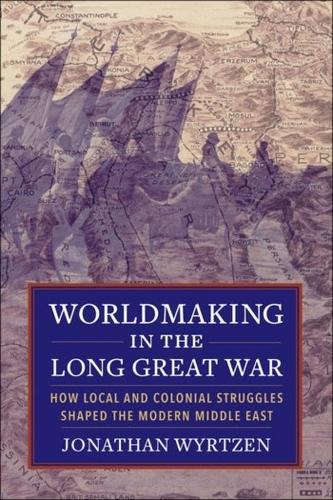
Книга Worldmaking in the Long Great War: How Local and Colonial Struggles Shaped the Modern Middle East
Winner, 2023 Robert L. Jervis and Paul W. Schroeder Best Book Award, International History and Politics Section, American Political Science Association
Honorable Mention, 2023 Barrington Moore Award, Comparative and Historical Sociology Section, American Sociological Association
Honorable Mention, 2023 Francesco Guicciardini Prize for Best Book in Historical International Relations, Historical International Relations Section, International Studies Association
It is widely believed that the political problems of the Middle East date back to the era of World War I, when European colonial powers unilaterally imposed artificial borders on the post-Ottoman world in postwar agreements. This book offers a new account of how the Great War unmade and then remade the political order of the region. Ranging from Morocco to Iran and spanning the eve of the Great War into the 1930s, it demonstrates that the modern Middle East was shaped through complex and violent power struggles among local and international actors.
Jonathan Wyrtzen shows how the cataclysm of the war opened new possibilities for both European and local actors to reimagine post-Ottoman futures. After the 1914–1918 phase of the war, violent conflicts between competing political visions continued across the region. In these extended struggles, the greater Middle East was reforged. Wyrtzen emphasizes the intersections of local and colonial projects and the entwined processes through which states were made, identities transformed, and boundaries drawn. This book’s vast scope encompasses successful state-building projects such as the Turkish Republic and the Kingdom of Saudi Arabia as well as short-lived political units—including the Rif Republic in Morocco, the Sanusi state in eastern Libya, a Greater Syria, and attempted Kurdish states—that nonetheless left traces on the map of the region. Drawing on a wide range of sources, Worldmaking in the Long Great War retells the origin story of the modern Middle East.
"Wyrtzen turns what might have been an overwhelming and dizzying array of subfields into a decisive argument for an updated perspective on a region and a war so often bogged down in Eurocentric, superficial, and dismissive cliches." - Developing Economies
"Especially and unreservedly recommended for community, college, and university library 20th Century Middle East History & Politics collections and supplemental curriculum studies syllabus." - Midwest Book Review
"An ambitious, and rather admirably compact, survey of history between 1911 and 1934...a very approachable volume capable of introducing students and scholars to the history of the early twentieth century...succinct and convincing." - Middle East Journal
"A major feature of Worldmaking in the long great war is the need to move decisively away from the ‘standard narrative’ that the Sykes–Picot Agreement, alongside other wartime agreements and postwar peace treaties, settled or imposed modern polities and boundaries across the Middle East." - International Affairs
"A thought-provoking history and will be of interest to readers with an interest in Middle Eastern and North African history and politics as well as modern European history." - Muslim World Book Review