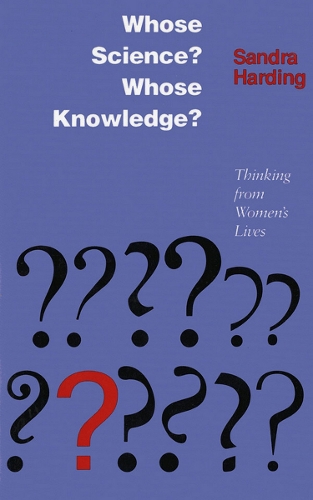
Книга Whose Science? Whose Knowledge?: Thinking from Women's Lives
Sandra Harding here develops further the themes first addressed in her widely influential book, The Science Question in Feminism, and conducts a compelling analysis of feminist theories on the philosophical problem of how we know what we know.Following a strong narrative line, Harding sets out her arguments in highly readable prose. In Part 1, she discusses issues that will interest anyone concerned with the social bases of scientific knowledge. In Part 2, she modifies some of her views and then pursues the many issues raised by the feminist position which holds that women's social experience provides a unique vantage point for discovering masculine bias and and questioning conventional claims about nature and social life. In Part 3, Harding looks at the insights that people of color, male feminists, lesbians, and others can bring to these controversies, and concludes by outlining a feminist approach to science in which these insights are central. "Women and men cannot understand or explain the world we live in or the real choices we have," she writes, "as long as the sciences describe and explain the world primarily from the perspectives of the lives of the dominant groups."Harding's is a richly informed, radical voice that boldly confronts issues of crucial importance to the future of many academic disciplines. Her book will amply reward readers looking to achieve a more fruitful understanding of the relations between feminism, science, and social life.
Whose Science, Whose Knowledge? represents a transition from gender to power considerations in Harding's continuous efforts to raise questions about the theory and practice of science.— Shulamit Reinharz ― Gender & Society
Harding's is a richly informed, radical voice that boldly confronts issues of crucial importance to the future of many academic disciplines. Her book will amply reward readers looking to achieve a more fruitful understanding of the relations between feminism, science, and social life.
Sandra Harding here develops further the themes first addressed in her widely influential book, The Science Question in Feminism, and conducts a compelling analysis of feminist theories on the philosophical problem of how we know what we know.
Following a strong narrative line, Harding sets out her arguments in highly readable prose. In Part 1, she discusses issues that will interest anyone concerned with the social bases of scientific knowledge. In Part 2, she modifies some of her views and then pursues the many issues raised by the feminist position which holds that women's social experience provides a unique vantage point for discovering masculine bias and and questioning conventional claims about nature and social life. In Part 3, Harding looks at the insights that people of color, male feminists, lesbians, and others can bring to these controversies, and concludes by outlining a feminist approach to science in which these insights are central. "Women and men cannot understand or explain the world we live in or the real choices we have," she writes, "as long as the sciences describe and explain the world primarily from the perspectives of the lives of the dominant groups."
"
Whose Science, Whose Knowledge? represents a transition from gender to power considerations in Harding's continuous efforts to raise questions about the theory and practice of science.
" - Gender & Society"
Harding's account offers a good insight into a variety of feminist responses to the hegemony apparently exercised by scientific thinking. Some readers will take the book as a challenge to the sociology of science to examine its arguments and assumptions in the light of standpoint theory and feminist postmodernism.
" - British Journal of Sociology"
This is an important book that has much to offer practicing scientists but probably will not be read by many of them. That is a shame, because its bold claims are usefully unsettling and its argument begs for engagement. One of the basic messages of Whose Science? Whose Knowledge?—that all fields of natural science are best analyzed from within the social sciences, of which they are logically a part, rather than taken as external models for the social sciences—has potential consequences for most, perhaps all, scientific practice.
" - Science