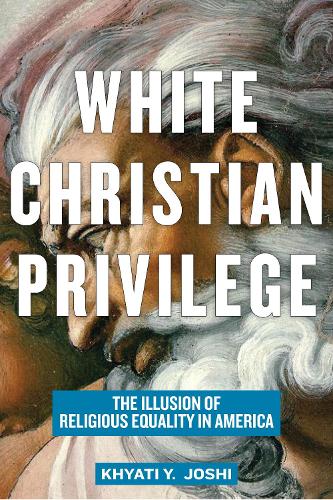
Книга White Christian Privilege: The Illusion of Religious Equality in America
Exposes the invisible ways in which white Christian privilege disadvantages racial and religious minorities in America
The United States is recognized as the most religiously diverse country in the world, and yet its laws and customs, which many have come to see as normal features of American life, actually keep the Constitutional ideal of “religious freedom for all” from becoming a reality. Christian beliefs, norms, and practices infuse our society; they are embedded in our institutions, creating the structures and expectations that define the idea of “Americanness.” Religious minorities still struggle for recognition and for the opportunity to be treated as fully and equally legitimate members of American society. From the courtroom to the classroom, their scriptures and practices are viewed with suspicion, and bias embedded in centuries of Supreme Court rulings create structural disadvantages that endure today.
In White Christian Privilege, Khyati Y. Joshi traces Christianity’s influence on the American experiment from before the founding of the Republic to the social movements of today. Mapping the way through centuries of slavery, westward expansion, immigration, and citizenship laws, she also reveals the ways Christian privilege in the United States has always been entangled with notions of White supremacy.
Through the voices of Christians and religious minorities, Joshi explores how Christian privilege and White racial norms affect the lives of all Americans, often in subtle ways that society overlooks. By shining a light on the inequalities these privileges create, Joshi points the way forward, urging readers to help remake America as a diverse democracy with a commitment to true religious freedom.
"Looking at America’s history—including slavery and westward expansion—White Christian Privilege explores how Christian privilege and white racial norms impact the lives of all Americans. The book demonstrates how Christian beliefs have been built into the Constitution and beyond, and the sometimes subtle and overlooked ramifications it has for religious minorities." - Publishers Weekly
"'In order to form a more perfect Union,' books such as White Christian Privilege add enormous value to highlighting the gap between illusion and reality." - New York Journal of Books
"Joshi explores the structures of white Christian privilege embedded in American institutions, laws, and culture ... insightful ... outlines examples of those who have the privilege but are blind to it, and some of the inequities suffered by uneven privilege. Recommended for readers interested in historical roots of religious freedom." - Library Journal
"From the first page of White Christian Privilege, Khyati Joshi makes it plain that she is not interested in euphemizing. Nor is she interested in gently nudging her audience— one comprised at least in part by, if not mostly by, the people whose privilege she is illuminating— into a more aware mindset. Instead, Joshi wastes no time by acknowledging the truth." - Englewood Review of Books
"By the time you have finished reading Khyati Joshi’s first chapter, in which she defines such things as 'separation of Church and State' and 'secularization' as optical illusions to mask the overwhelming dominance of Christianity in American culture, you wonder if you might have stumbled upon a gem. By the time you are finished, you might find yourself wondering if you’ve finished a new classic." - Journal of Interreligious Studies
"Books that unpack problems in and questions about religion and race always feel timely in America; however, Joshi’s intersectional and social justice-grounded approach makes this a necessary read for those who desire a more just America. The book’s accessibility for students and the general public make its contribution all the stronger and more important" - Religions Journal
"Joshi explores how Christian privilege and White racial norms affect the lives of all Americans, often in subtle ways that society overlooks. By shining a light on the inequalities these privileges create, Joshi points the way forward, urging readers to help remake America as a diverse democracy with a commitment to true religious freedom." - Anthropology Book Forum
"Joshi’s historical account is one thing, but her ability to bring the reader into her more than two decades of scholarship and practice, offering solutions to long standing issues and concerns within society is some of the most important methodology of the last decade or more. Overall, the book is refreshing, challenging, and timely. The reader should be prepared to experience this book all the way from beginning to end." - Journal of Interreligious Studies
"In embracing a head, heart, and hand approach to bringing about religious social justice, Joshi highlights the concept of lived religion—how people within same-named faith communities practice differently, based on personal choice, sociopolitical circumstance, cultural nuance, and other differentiating influences." - Journal of Church and State