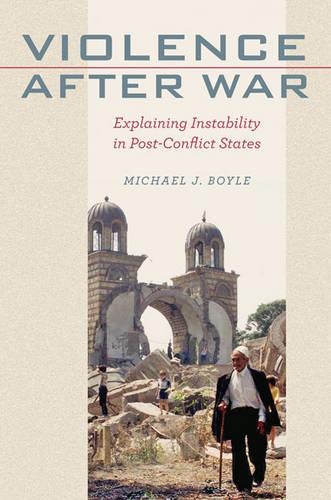
Книга Violence after War: Explaining Instability in Post-Conflict States
The tendency to associate the actual end of an armed conflict with the formal cessation of the hostilities that accompanied it comes naturally. It also remains widespread. It is still commonplace, for example, to speak of the Second Congo War as having ended in late 2002, when an assortment of parties meeting in Pretoria committed themselves to peace on paper. In this impressive new study, Michael Boyle shows how mistaken, and potentially dangerous, is the view that the formal end of war also marks an end to violence. Expertly pulling together evidence from a wide range of era-defining case studies, he unravels the 'complex mix of personal, criminal, and political violence' that is a feature, albeit to varying degrees and assuming different forms, of all, so-called, 'post-conflict' societies. In doing so, he has provided policy makers and students of violent conflict alike with important conceptual tools for the analysis of 'post-conflict' violence more generally. Violence after War deserves a wide readership. -- Mats Berdal, King's College London Despite two decades of scholarship on civil wars, little has been written on the violence that often pervades post-conflict societies-that is until now. Violence after War fills a large void in our understanding of post-conflict violence and does so with tremendous insight and detail. I recommend it highly. -- Monica Duffy Toft, University of Oxford Boyle breaks new substantive ground in explaining the causes of post-civil war violence. He should be commended not only for extensive field and archival research but also for painstaking data collection. -- Alexander B. Downes, George Washington University
The end of one war is frequently the beginning of another because the cessation of conflict produces two new challenges: a contest between the winners and losers over the terms of peace, and a battle within the winning party over the spoils of war. As the victors and the vanquished struggle to establish a new political order, incidents of low-level violence frequently occur and can escalate into an unstable peace or renewed conflict. Michael J. Boyle evaluates the dynamics of post-conflict violence and their consequences in Violence after War. In this systematic comparative study, Boyle analyzes a cross-national dataset of violent acts from 52 post-conflict states and examines, in depth, violence patterns from five recent post-conflict states: Bosnia, Rwanda, Kosovo, East Timor, and Iraq. In each of the case studies, Boyle traces multiple pathways through which violence emerges in post-conflict states and highlights how the fragmentation of combatants, especially rebel groups, produces unexpected and sometimes surprising shifts in the nature, type, and targets of attack. His case studies are based on unpublished data on violent crime, including some from fieldwork in Kosovo, East Timor, and Bosnia, and a thorough review of narrative and witness accounts of the attacks. The case study of Iraq comes from data that Boyle obtained directly from U.S. Central Command, published here for the first time. Violence after War will be essential reading for all those interested in political violence, peacekeeping, and post-conflict reconstruction.