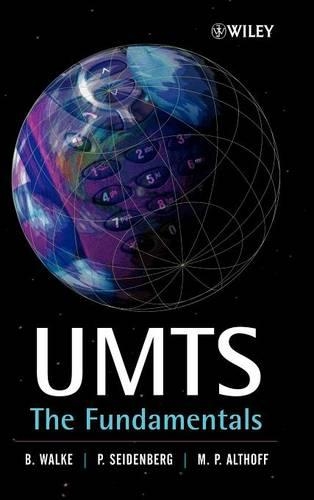
Книга UMTS: The Fundamentals
UMTS (Universal Mobile Telecommunication System) is the third generation telecommunications system based on WCDMA. WCDMA (Wideband Code Division Multiple Access) is the radio interface for UMTS. WCDMA is characterised by use of a wider band than CDMA. It has additional advantages of high transfer rate, and increased system capacity and communication quality by statistical multiplexing, etc. WCDMA efficiently utilises the radio spectrum to provide a maximum data rate of 2 Mbit/s.
UMTS (Universal Mobile Telecommunication System) will offer a consistent set of services to mobile computer and phone users no matter where they are located in the world. Based on the GSM (Global System for Mobile communication) communication standard, UMTS, endorsed by major standards bodies and manufacturers, is the planned standard for mobile users around the world by 2002.
Today's cellular telephone systems are mainly circuit-switched, with connections always dependent on circuit availability. Packet-switched connection, using the Internet Protocol (IP), means that a virtual connection is always available to any other end point in the network. It will also make it possible to provide new services, such as alternative billing methods (pay-per-bit, pay-per-session, flat rate, asymmetric bandwidth, and others). The higher bandwidth of UMTS also promises new services, such as video conferencing and promises to realise the Virtual Home Environment (VHE) in which a roaming user can have the same services to which the user is accustomed when at home or in the office, through a combination of transparent terrestrial and satellite connections.
* Provides an introduction to cellular networks and digital communications
* Covers the air interface, radio access network and core network
* Explains the Release '99 specifications clearly and effectively
* Discusses UMTS services and future services beyond 3G
* Features numerous problems and solutions in order to aid understanding
Ideal for Academics and students on telecommunications, electronics and computer science courses, research and development engineers working in mobile/wireless communications and Cellular operators and technical consultants.UMTS (Universal Mobile Telecommunication System) ist die dritte Generation von Telekommunikationssystemen und beruht auf der Funkschnittstelle WCDMA (Wideband Code Division Multiple Access). WCDMA bietet im Vergleich zu CDMA Vorteile durch die Nutzung eines breiteren Übertragungsbandes, eine hohe Übertragungsrate (maximal 2 Mbit/s) sowie eine gesteigerte Systemkapazität und Kommunikationsqualität durch statistisches Multiplexing. UMTS macht Dienste für die Benutzer von mobilen Computern und Mobiltelefonen unabhängig von ihrem Standort zugänglich und ermöglicht innovative Dienste (zum Beispiel pay-per-bit, pay-per-session, flat rate, asymmetric bandwidth, Video Conferencing, Virtual Home Environment und andere). Dieser Band führt Sie in zellulare Netze und die digitale Kommunikation ein. Behandelt werden die Funkschnittstelle, der Funkzugang und das Basisnetzwerk. Gut verständlich werden die 99er Spezifikation erklärt sowie UMTS-Dienste und zukünftige Dienste, die über 3G hinausgehen, vorgestellt. Viele Übungsaufgaben, teils mit Lösungen, erleichtern das Vertiefen des Stoffes.