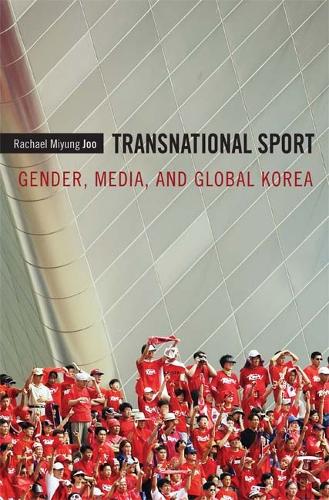
Книга Transnational Sport: Gender, Media, and Global Korea
Anthropologist Rachael Joo explores the gendered and mediated role of sports in producing a Korean sense of self on a global stage. She looks at the 2002 Japan/Korea FIFA World Cup, first as a participant observer with fans in Seoul and later through interviews in Koreatown in Los Angeles, comparing the nationalist identifications across this transnational frame. She also looks at the emergence of young female Korean golfers, their success in the LPGA, and how that is received in Korea and in the US. She compares the different forms of national identification mobilized around male and female athletes, and the role of sports media in producing these gendered narrations.
Based on ethnographic research in Seoul and Los Angeles, Transnational Sport tells how sports shape experiences of global Koreanness, and how those experiences are affected by national cultures. Rachael Miyung Joo focuses on superstar Korean athletes and sporting events produced for transnational media consumption. She explains how Korean athletes who achieve success on the world stage represent a powerful, globalized Korea for Koreans within the country and those in the diaspora. Celebrity Korean women athletes are highly visible in the Ladies Professional Golf Association. In the media, these young golfers are represented as daughters to be protected within the patriarchal Korean family and as hypersexualized Asian women with commercial appeal. Meanwhile, the hard-muscled bodies of male athletes, such as Korean baseball and soccer players, symbolize Korean masculine dominance in the global capitalist arena. Turning from particular athletes to a mega-event, Joo discusses the 2002 FIFA World Cup Korea/Japan, a watershed moment in recent Korean history. New ideas of global Koreanness coalesced around this momentous event. Women and youth assumed newly prominent roles in Korean culture, and, Joo suggests, new models of public culture emerged as thousands of individuals were joined by a shared purpose.
"“Joo’s use of ethnographic material, participant observation, and interviews are justifiably necessary and highly enriching to her study of the negotiations between gender, media, and global Korea.”" - International Journal of Communication
"“Transnational Sport is an accessible yet rigorously written book that will help closely investigate the world that transnational/Korean media sport has made. Thus, the book is highly recommended for courses on, as well as for scholars and students in the fields of, anthropology, sociology, and cultural studies of sport; Asian American studies; and Asian studies.”" - Journal of Asian Studies
"“Transnational Sport makes an excellent contribution to both Korean and Korean American studies by offering thoughtful analyses of wide-ranging interesting data and critical ethnographic commentaries on the sociocultural and political economic significance of transnational media sport.”" - American Ethnologist
"“Rachael Miyung Joo presents a well-rounded look at transnational sport in her book. It covers many important and interesting topics. . . .[The] content of each topic is informative and the analysis, inspiring. . . . The various topics discussed in the book offer multiple entries for worthwhile comparison beyond South Korea alone.”" - Asian Anthropology
"Writing in clear authoritative prose and avoiding the jargon of historical discourse and examined identity, Joo provides clear explanations in each chapter of her main points and conclusions. . . . Recommended." - Choice
"Joo... advance[s] our understanding of the key roles that sports play in gendering societies in Asia, but with clear application to other parts of the world. [Transnational Sport is] invaluable for researchers, and I highly recommend [the book] for classroom use." - Signs