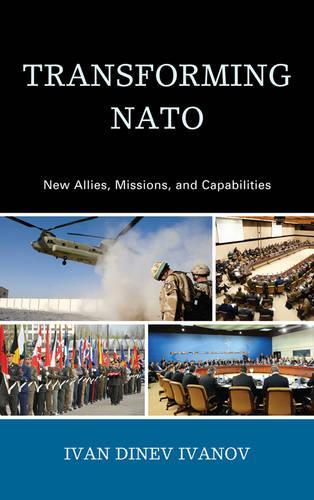
Книга Transforming NATO: New Allies, Missions, and Capabilities
Transforming NATO: New Allies, Missions, and Capabilities, by Ivan Dinev Ivanov, examines the three dimensions of NATO’s transformation since the end of the Cold War: the addition of a dozen new allies; the undertaking of new missions such as peacekeeping, crisis response, and stabilization; and the development of new capabilities to implement these missions. The book explains these processes through two mutually reinforcing frameworks: club goods theory and the concept of complementarities. NATO can be viewed as a diverse, heterogeneous club of nations providing collective defense to its members, who, in turn, combine their military resources in a way that enables them to optimize the Alliance’s capabilities needed for overseas operations. Transforming NATO makes a number of theoretical contributions. First, it offers new insights into understanding how heterogeneous clubs operate. Second, it introduces a novel concept, that of complementarities. Finally, it re-evaluates the relevance of club goods theory as a framework for studying contemporary international security. These conceptual foundations apply to areas well beyond NATO. They provide useful insights into understanding the operation of transatlantic relations, alliance politics, and a broader set of international coalitions and partnerships. This update in April 2013 covers new developments related to NATO’s transformation after this book was originally published: http://homepages.uc.edu/~ivanovid/pdfs/book_update.pdf
"Ivanov (Univ. of Cincinnati) provides a novel, interesting set of analytical approaches to examine NATO's post-Cold War missions, capabilities, and new members. The author advances the ideas of club goods theory as well as "complementarities" to help understand the widespread changes in NATO's evolution from a conservative Cold War military alliance to the current, ever-expanding role it plays in global security affairs. Ivanov views all of these changes in a rather holistic sense, noting how new missions impact new members, as well as result in an expansion of different capabilities. This book offers an excellent overview of the many changes witnessed in the aftermath of the Soviet Union's collapse, including examinations of NATO's operations in the Balkans, as well as an excellent chapter on NATO's struggling mission in Afghanistan. Chapter 5, which focuses upon NATO's newest allies and various partners that work with the alliance, is another especially useful chapter. Ivanov draws from an extensive body of NATO scholarship as well as his own personal interviews to produce an impressive addition to the literature. Summing Up: Recommended. Undergraduate readers and above." - CHOICE