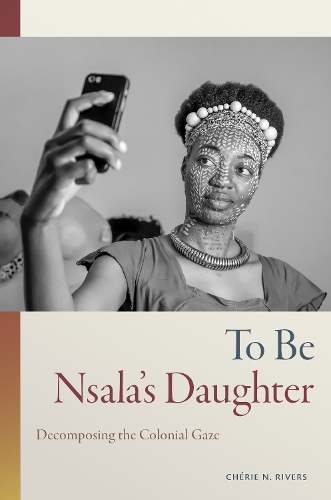
Книга To Be Nsala's Daughter: Decomposing the Colonial Gaze
In To Be Nsala’s Daughter, Chérie N. Rivers shows how colonial systems of normalized violence condition the way we see and, through collaboration with contemporary Congolese artists, imagines ways we might learn to see differently. Rivers focuses on a photograph of a Congolese man, Nsala, looking at the disembodied hand and foot of his daughter, which were removed as punishment for his failure to deliver the requisite amount of rubber in King Léopold’s Congo. This photograph, taken by British missionary Alice Seeley Harris, featured prominently in abolitionist campaigns to end colonial atrocities in Central Africa in the early twentieth century. But in addition to exposing the visible violence of colonialism, Rivers argues, this photograph also exposes the invisible—and continued—violence of the colonial gaze. With a poetic, personal collage of stories and images, To Be Nsala’s Daughter traces the past and present of the colonial gaze both in Congo and in the author’s lived experience as a mixed-race Black woman in the United States.
""To Be Nsala’s Daughter is an impressive feat of scholarship, and yet reflects true humility on the part of its creator, as it recognizes that grappling with the cascades, ruptures, and fault lines of cultural geography are always a work in progress. The book . . . makes an excellent companion piece for undergraduate courses on imperialism, African and African American history, and visual culture. In its nuanced, sophisticated assessments of race, systemic violence, and frames of knowledge, the book is a perfect choice for instructors seeking to meaningfully engage with issues of diversity, equity, inclusion, and social justice, particularly when a transnational approach is desired or required."" - The AAG Review of Books
"The lyrical prose paired with intellectually rigorous theory make To Be Nsala’s Daughter a generative text for anyone working on postcolonial theory, decolonizing methodologies, or grappling with techniques for addressing archival silences and gaps." - Theatre Journal