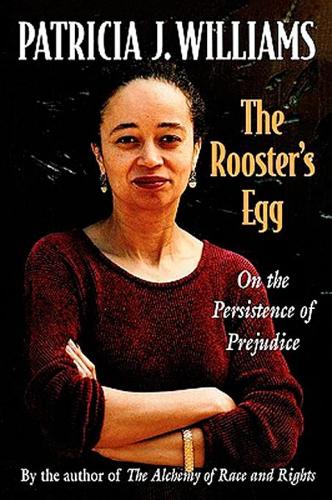
Книга The Rooster’s Egg
In her second book, Professor Williams turns a focused look at what forces in American society result in the 'persistence of prejudice.' This baker's dozen of essays covers a wide range of topics, including talk show 'town halls,' single mothers, talk radio, Lani Guinier, welfare, Clarence 'X' Thomas, affirmative action, and adoption. With disarming wit, Williams skillfully and pointedly uses stories, anecdotes, and analysis to examine these and other issues...The Alchemy of Race and Rights [her previous book], and The Rooster's Egg will frustrate, disquiet and aggravate some readers by relentlessly delving into the changing and often hidden facets of racism or sexism. But this is her intent. -- Lea B. Vaughn, University of Washington School of Law
“Jamaica is the land where the rooster lays an egg…When a Jamaican is born of a black woman and some English or Scotsman, the black mother is literally and figuratively kept out of sight as far as possible, but no one is allowed to forget that white father, however questionable the circumstances of birth…You get the impression that these virile Englishmen do not require women to reproduce. They just come out to Jamaica, scratch out a nest and lay eggs that hatch out into ‘pink’ Jamaicans.”
—Zora Neale Hurston
We may no longer issue scarlet letters, but from the way we talk, we might as well: W for welfare, S for single, B for black, CC for children having children, WT for white trash. To a culture speaking with barely masked hysteria, in which branding is done with words and those branded are outcasts, this book brings a voice of reason and a warm reminder of the decency and mutual respect that are missing from so much of our public debate. Patricia J. Williams, whose acclaimed book The Alchemy of Race and Rights offered a vision for healing the ailing spirit of the law, here broadens her focus to address the wounds in America’s public soul, the sense of community that rhetoric so subtly but surely makes and unmakes.
In these pages we encounter figures and images plucked from headlines—from Tonya Harding to Lani Guinier, Rush Limbaugh to Hillary Clinton, Clarence Thomas to Dan Quayle—and see how their portrayal, encoding certain stereotypes, often reveals more about us than about them. What are we really talking about when we talk about welfare mothers, for instance? Why is calling someone a “redneck” okay, and what does that say about our society? When young women appear on Phil Donahue to represent themselves as Jewish American Princesses, what else are they doing? These are among the questions Williams considers as she uncovers the shifting, often covert rules of conversation that determine who “we” are as a nation.
"Written in a personal and anecdotal style from the author’s perspective as a professor, a single black mother, and (much less important) a lawyer… Many [of Williams’s essays] are inspired by a popular event or personality, which becomes the springboard for her hyper-intelligent musings… She emerges as a thoughtful social critic from the left… Her arguments are anything but doctrinaire." - New York Times Book Review
"[Williams’s] overall contribution to contemporary political debate is invaluable. Her insights are complex and compelling. Few today see so clearly, and write so engagingly, about the prejudice that has settled so insidiously into our lives." - In These Times
"Williams…writes with passion from a feminist/neo-Marxist point of view, demonstrating how the tolerance of intolerance helps to keep enshrined segregation and prejudice in a society which is theoretically integrated." - Jewish Chronicle
"In The Rooster’s Egg…Patricia Williams brings her searing and formidable intellect to a vast array of the images, texts and practices of American popular culture, analysing them along lines of race, gender, class, culture, and sexual orientation." - Canadian Philosophical Reviews
"The Rooster’s Egg is masterfully crafted and complex. Williams’s outrage and despair leavened by her insight and wit make her perhaps uniquely able to get us past that Catch-22 that leads to either silence or hostility to a place where a conversation about prejudice can occur." - Contemporary Sociology
"Williams’s writing exceeds the usual boundaries of legal, and even of political, concerns. Her focus remains the translation of beliefs and values, including her own, into various legal, social, pedagogical and political practices… What emerge in these essays are the consequences of received and esteemed social knowledges, for the ‘market’ in adoptive children, for the survival of black families, for justice, for communal ties and for the aspirations of racially marked people… [This book] will be enormously useful to those who wish to challenge the racial, ethnic, gender and national solipsism of much of what passes for foundational ‘knowledge.’" - Feminism & Psychology
"The latest book by Patricia Williams has two striking features. The first is its breadth. In the course of thirteen short chapters, Williams takes a brisk tour of contemporary American politics and culture… Beyond its eclecticism, William’s book is also striking because of its sheer readability. Unlike many law professors who have abandoned academic convention for the sake of presenting narratives, Williams writes with engaging style. She knows how to turn a phrase and how to tell a good story—two talents which permit her to produce enviably fluid prose… Her insights into the varied notions of identity, difference, and value embedded within a range of contemporary debates are truly first rate." - Law and Politics Book Review
"[The Rooster’s Egg] serves as a reminder that the problem of race is a constant yet to be addressed by the powers that be… The analysis comes from a female voice with enough clarity, stylings, and strength to make it a fresh and forceful analysis… This is a commendable contribution by a strong and commanding African-American female voice." - New York Law Journal
"Patricia Williams’s The Rooster’s Egg…extols the utility of a heterogeneous approach and the radical possibilities of narrative—or, indeed ‘narrative jurisprudence’. Although not highly theoretical, Williams (once again) draws the discourses of law, race, sex and class into a sustained critique of U.S. identity politics. In the midst of, and perhaps in defiance of, criticism of autobiographical legal scholarship…Williams seamlessly incorporates personal narrative into her objective analysis, and makes striking connections between race and the often neglected discourse of class." - Year’s Work in English Studies