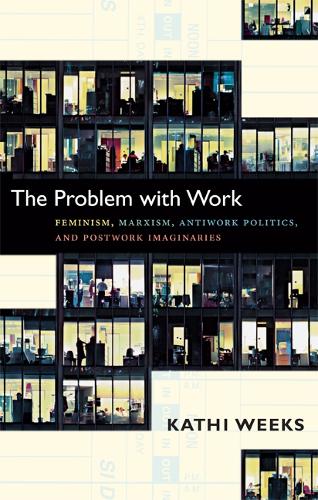
Книга The Problem with Work: Feminism, Marxism, Antiwork Politics, and Postwork Imaginaries
Challenges the presupposition that work, or waged labour, is inherently a social and political good
In The Problem with Work, Kathi Weeks boldly challenges the presupposition that work, or waged labor, is inherently a social and political good. While progressive political movements, including the Marxist and feminist movements, have fought for equal pay, better work conditions, and the recognition of unpaid work as a valued form of labor, even they have tended to accept work as a naturalized or inevitable activity. Weeks argues that in taking work as a given, we have “depoliticized” it, or removed it from the realm of political critique. Employment is now largely privatized, and work-based activism in the United States has atrophied. We have accepted waged work as the primary mechanism for income distribution, as an ethical obligation, and as a means of defining ourselves and others as social and political subjects. Taking up Marxist and feminist critiques, Weeks proposes a postwork society that would allow people to be productive and creative rather than relentlessly bound to the employment relation. Work, she contends, is a legitimate, even crucial, subject for political theory.
"“[Weeks] convincingly shows how an imperative to be productive, at work, in the home, school and in life generally (’Five Top Tips for Productive Dating Profiles!’), is central to the way capitalism not only puts us to work but makes us want to be put to work. We think work is right and just and when we imagine another world, even a ‘post-revolutionary world’, we imagine a world of work. Weeks argues that we need to break the hold that work has on our imaginations.”" - Red Pepper
"“The Problem with Work ... raise[s] key issues for feminism, including the question of whether capitalism can serve the interests of women today and in the future... Th[is book] should be widely read, discussed, and debated...”" - Signs
"“There’s no better way to spend the summer months than by thinking about waged labor, which is why I’m currently reading The Problem with Work, an inventive examination of how seemingly reformist measures such as universal basic income and reduced workweeks can be used as stepping stones toward a world beyond the daily grind.”" - The Nation
"“The Problem with Work . . . is bold for several reasons. Not the least of which is for its fundamental argument that work should be understood as a concern of political theory, that work is a matter of power and domination as much as it is productivity and economics. This academic provocation aside, Weeks’ book is bold in taking up the critique of work, in claiming anti-work politics. In doing so it breaks both with the dominant ideology that makes work a testament to one’s moral worth and with the center-left contestation of this ideology that demands more aggressive jobs programs to put people to work.”" - Unemployed Negativity blog
"“[T]his is well worth a read, as Weeks presents a set of imaginative and insightful ideas in a clear and thoroughly argued format.”" - Socialist Review
"“Faced with the neoliberal fiat that market values now define what is valuable as such, and that now, more than ever, work is the sole aim for which we all must live, Kathi Weeks stares back without blinking and demands something different. She urges readers to insist on less work and more money, and to do so in a self-consciously militant, utopian register. Combining an imaginative critique of neoliberalism’s warp-drive work ethic with a subtle and badly needed recuperation of the utopian as a mode of political theory and action, The Problem with Work makes a vital contribution to feminist theory, Marxist theory, and the growing political-theoretical literature on time and temporality.”" - Theory & Event