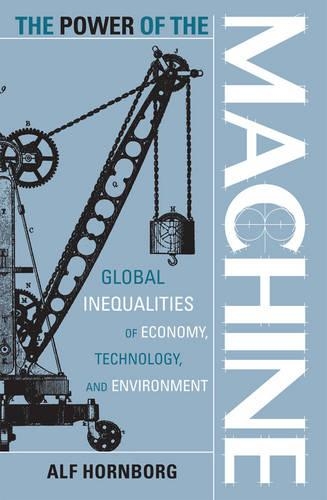
Книга The Power of the Machine: Global Inequalities of Economy, Technology, and Environment
Hornborg argues that we are caught in a collective illusion about the nature of modern technology that prevents us from imagining solutions to our economic and environmental crises other than technocratic fixes. He demonstrates how the power of the machine generates increasingly asymmetrical exchanges and distribution of resources and risks between distant populations and ecosystems, and thus an increasingly polarized world order. The author challenges us to reconceptualize the machine—"industrial technomass"—as a species of power and a problem of culture. He shows how economic anthropology has the tools to deconstruct the concepts of production, money capital, and market exchange, and to analyze capital accumulation as a problem at the very interface of the natural and social sciences. His analysis provides an alternative understanding of economic growth and technological development. Hornborg's work is essential for researchers in anthropology, human ecology, economics, political economy, world-systems theory, environmental justice, and science and technology studies. Find out more about the author at the Lund University, Sweden web site.
"The strength of the book is its interdisciplinarity....This book would be appropriate reading for those social scientists, whether anthropologists, sociologists, political scientists, or environmentalists, interested in global studies, Marxist critiques of culture, human-environmental relations, and science and technology studies." - Journal Of World-Systems Research
"At a time when some paleobiologists are predicting that humanity has so fouled its nest that our planet will eventually be ceded to rats and ants, Alf Hornborg is more hopeful... [an] ambitious, thought -provoking study of the tensions between conservation and economic development...Hornborg is convincing. He says one of anthropology's greatest challenges is to deconstruct the most powerful discourses of our time which present themselves as somehow above and beyond culture." - Anthropological Theory
"Hornborg's The Power of the Machine offers a rich theoretical analysis of how technology masks the inequalities between nations, humans, and ecosystems within the World System... he challenges conventional political economic and sociological perspectives about global underdevelopment... As a truly interdisciplinary writer, Hornborg combines perspectives from natural science, political economy, and cultural anthropology to critique not only global unequal exchange but also the very categories that we, as social scientists, use to analyze such exchange... The strength of this book is its interdisciplinarity. One would hope to find an interdisciplinary focus in a volume written by several authors, but not expect to find such focus in a single-authored text... I appreciate Hornberg's two-pronged goal: not only does he demonstrate how technology operates as a mechanism of Western hegemony but he challenges us as social scientists to be wary of the role that we play in analyzing such inequities — to not reify the machine is to call global exchange by its real name: deliberate uneven development." - Journal Of World Systems Research, Ix, I, Winter 2003
"Hornborg will be aware of the irony that his thoroughly modern study (professional erudition, academic logic and technique, mass-produced book aimed at an academic audience, etc.) is a radical critique of the conditions of its own production. But in so doing Hornborg poses new and interesting questions. By also suggesting how we might approach the issues they raise the author has made a major contribution to debates about modernity, global inequalities, technology and the fate of the environment." - Ethnos
"This is one of the most thought provoking books I've read lately... Hornborg wants to understand how it is that relations of power come to seem inevitable and natural... He urges a truly holistic study of humankind. We Americans would all do well to follow his example and learn from one another." - Journal of Anthropological Research, Vol. 59, 2003