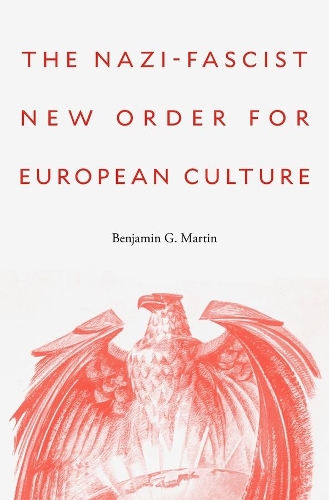
Книга The Nazi-Fascist New Order for European Culture
Following France’s crushing defeat in June 1940, the Nazis moved forward with plans to reorganize a European continent now largely under Hitler’s heel. While Germany’s military power would set the agenda, several among the Nazi elite argued that permanent German hegemony required something more: a pan-European cultural empire that would crown Hitler’s wartime conquests. At a time when the postwar European project is under strain, Benjamin G. Martin brings into focus a neglected aspect of Axis geopolitics, charting the rise and fall of Nazi-fascist “soft power” in the form of a nationalist and anti-Semitic new ordering of European culture.
As early as 1934, the Nazis began taking steps to bring European culture into alignment with their ideological aims. In cooperation and competition with Italy’s fascists, they courted filmmakers, writers, and composers from across the continent. New institutions such as the International Film Chamber, the European Writers Union, and the Permanent Council of composers forged a continental bloc opposed to the “degenerate” cosmopolitan modernism that held sway in the arts. In its place they envisioned a Europe of nations, one that exalted traditionalism, anti-Semitism, and the Volk. Such a vision held powerful appeal for conservative intellectuals who saw a European civilization in decline, threatened by American commercialism and Soviet Bolshevism.
Taking readers to film screenings, concerts, and banquets where artists from Norway to Bulgaria lent their prestige to Goebbels’s vision, Martin follows the Nazi-fascist project to its disastrous conclusion, examining the internal contradictions and sectarian rivalries that doomed it to failure.
"As Benjamin G. Martin shows in his bold and impressive book, Germany, in close collaboration with Mussolini’s Italy, tried to recast European culture in accordance with their ideological aims…Martin’s book is a work of great originality because it does not focus on the art, nor on individual artists, film-makers and writers, but instead draws our attention to the policies enacted by the Nazi-fascist regimes to transform the cultural market. Martin shows how even the reform of entertainment taxes, royalty payments and artists’ contracts was charged with ideology." - New Statesman
"Narrated with great erudition and grace…The insidious spread of what Martin calls ‘the soft power of Nazi and fascist imperialism’ is a staggering tale of geopolitical and intellectual ambition. It is all the more astonishing for having been overlooked for so long. Drawing upon libraries and archives in five different countries, Martin’s work is a dazzling transnational history of ideas and institutions as well as a major contribution to our understanding of fascism and the Third Reich: Martin reveals how cultural initiatives unlock the political imagination of the interwar radical right. It was in concert halls and boardrooms and along red carpets that sinister ideologues like Goebbels most fully revealed their plans to remake European civilization and overturn the global order. The book also lands with more shuddering force than its author could have anticipated. More than any moment since the 1930s, we suddenly face the prospect of a world system principally shaped by the extreme right. With the European Union in peril, Russia extending its reach, and authoritarian nationalists seducing the disaffected, Martin’s study of ‘totalitarian internationalism’ turns out to be precisely the sort of history we need at this particular moment: a deft and disquieting account of how easily the noblest of liberal principles may be hollowed out and swiftly renovated for darker purpose." - New Republic
"[An] illuminating book…[Hitler and Mussolini] thought literature and the arts were important, and wanted to weaponize them as adjuncts to military conquest. Martin’s book adds a significant dimension to our understanding of how the Nazi and Fascist empires were constructed…Hitler (with Mussolini struggling behind) tried with at least some initial success to use international cultural organizations to enhance his military power. This story has been approached mostly, if at all, in individual national terms, but Martin has brought the whole Axis cultural project admirably into focus." - New York Review of Books