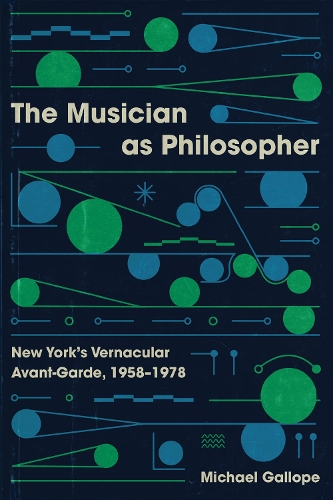
An insightful look at how avant-garde musicians of the postwar period in New York explored the philosophical dimensions of music’s ineffability.
The Musician as Philosopher explores the philosophical thought of avant-garde musicians in postwar New York: David Tudor, Ornette Coleman, the Velvet Underground, Alice Coltrane, Patti Smith, and Richard Hell. It contends that these musicians—all of whom are understudied and none of whom are traditionally taken to be composers—not only challenged the rules by which music is written and practiced but also confounded and reconfigured gendered and racialized expectations for what critics took to be legitimate forms of musical sound. From a broad historical perspective, their arresting music electrified a widely recognized social tendency of the 1960s: a simultaneous affirmation and crisis of the modern self.
"“In his first book Deep Refrains: Music, Philosophy and the Ineffable (2017), musician and academic Michael Gallope explored the ways in which music inspired modern European philosophers. With The Musician as Philosopher, he turns to the philosophical thinking of musicians themselves, with a focus on the ‘strange, intense, disorienting’ musical irruptions of New York’s postwar avant-grade. It’s refreshing to see [Ornette] Coleman’s philosophy taken seriously and Gallope pays equal respect to Alice Coltrane's engagement with Eastern philosophy. The Coltrane chapter is perhaps the richest in the book, bringing her musical and spiritual practices together… While tracing the commonalities between these artists, Gallope recognizes the complex dynamics of class, race, gender and sexuality… He describes his approach as an immanent critique and it would be fascinating to read his take on the vernacular avant grades of disc, hip-hop and no wave, all vital sites of hyperfracture and alchemy." - Stewart Smith, The Wire
" . . . . anyone seriously interested in
the artists concerned will find much to get
their teeth into here." - Shindig! Magazine