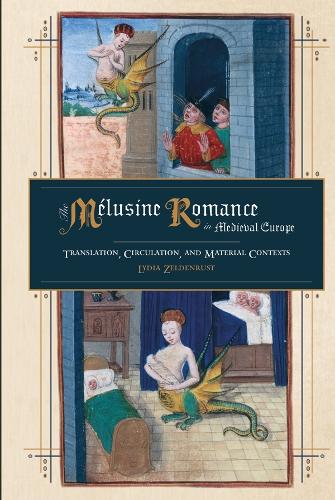
The legend of Mélusine examined in a pan-European context.
Readers have long been fascinated by the enigmatic figure of Mélusine - a beautiful fairy woman cursed to transform into a half-serpent once a week, whose part-monstrous sons are the ancestor of several European noble houses. This study is the first to consider how this romance developed from a local legend to European bestseller, analysing versions in French, German, Castilian, Dutch, and English. It addresses questions on how to study medieval literature from a European perspective, moving beyond national canons, and reading Mélusine's bodily mutability as a metaphor for how the romance itself moves and transforms across borders. It also analyses key changes to the romance's content, form, and material presentation - including its images - and traces how the people who produced and consumed this romance shaped its international transmission and spread. The author shows how Mélusine's character is adapted within each local context, while also uncovering previously unknown connections between the different branches of this multilingual tradition. Moving beyond established paradigms of separate national traditions, manuscript versus print, and medieval versus Renaissance literature, the book integrates literary analysis with art historical and book historical approaches.
"The Mélusine Romance in Medieval Europe is a refreshing and rigorous investigation into the European Mélusine romance tradition." - NOTTINGHAM MEDIEVAL STUDIES
"Zeldenrust [...] offers an important contribution to studies of the Mélusine romance. By placing the Mélusine romance in a broad literary and historical context, Zeldenrust expands on previous studies that focus primarily on French versions." - CHOICE
"[I]mpressively wide-ranging and engaging... Zeldenrust's work is a vital, informative, and original contribution to scholarship on this important, spellbinding narrative tradition." - MEDIEVAL REVIEW
"Zeldenrust's comparative exploration produces innovative insights and revisits well-traveled topics from new perspectives." - STUDIES IN THE AGE OF CHAUCER