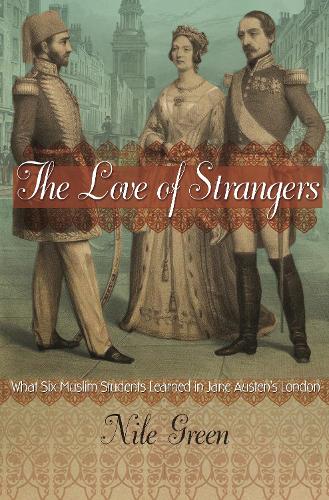
Книга The Love of Strangers: What Six Muslim Students Learned in Jane Austen's London
How a group of Iranian students sought love and learning in Jane Austen's London
In July 1815, six Iranian students arrived in London under the escort of their chaperone, Captain Joseph D'Arcy. Their mission was to master the modern sciences behind the rapid rise of Europe. Over the next four years, they lived both the low life and high life of Regency London, from being down and out after their abandonment by D’Arcy to charming their way into society and landing on the gossip pages. The Love of Strangers tells the story of their search for love and learning in Jane Austen’s England.
Drawing on the Persian diary of the student Mirza Salih and the letters of his companions, Nile Green vividly describes how these adaptable Muslim migrants learned to enjoy the opera and take the waters at Bath. But there was more than frivolity to their student years in London. Burdened with acquiring the technology to defend Iran against Russia, they talked their way into the observatories, hospitals, and steam-powered factories that placed England at the forefront of the scientific revolution. All the while, Salih dreamed of becoming the first Muslim to study at Oxford.
The Love of Strangers chronicles the frustration and fellowship of six young men abroad to open a unique window onto the transformative encounter between an Evangelical England and an Islamic Iran at the dawn of the modern age. This is that rarest of books about the Middle East and the West: a story of friendships.
"Nile Green . . . has followed the Iranian students through Regency England with the determination and skill of a forensic detective. Using the diary of Mirza Salih as his primary guide, he has managed to trace his subjects through disparate archives, scattered letters, newspaper articles and even paintings. Such a feat is not to be underestimated." - The New York Times
"A mesmerizing and winsome work." - The Star Tribune
"This fascinating study of six Iranian students in Regency London provides a positive counterpoint to two scholarly frameworks for interpreting encounters between East and West. . . . This book is a valuable contribution to the study of East-West encounters generally, and one that complicates the narratives that usually frame them." - Choice