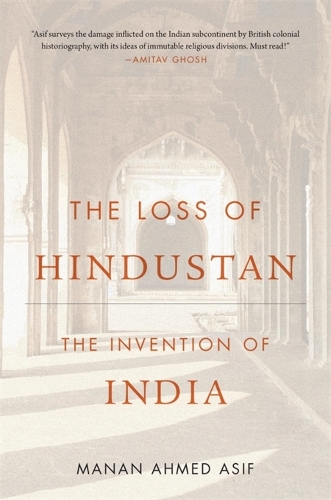
Книга The Loss of Hindustan: The Invention of India
Shortlisted for the Cundill History Prize
“Remarkable and pathbreaking…A radical rethink of colonial historiography and a compelling argument for the reassessment of the historical traditions of Hindustan.”
—Mahmood Mamdani
“The brilliance of Asif’s book rests in the way he makes readers think about the name ‘Hindustan’…Asif’s focus is Indian history but it is, at the same time, a lens to look at questions far bigger.”
—Soni Wadhwa, Asian Review of Books
“Remarkable…Asif’s analysis and conclusions are powerful and poignant.”
—Rudrangshu Mukherjee, The Wire
“A tremendous contribution…This is not only a book that you must read, but also one that you must chew over and debate.”
—Audrey Truschke, Current History
Did India, Pakistan, and Bangladesh have a shared regional identity prior to the arrival of Europeans in the late fifteenth century? Manan Ahmed Asif tackles this contentious question by inviting us to reconsider the work and legacy of the influential historian Muhammad Qasim Firishta, a contemporary of the Mughal emperors Akbar and Jahangir. Inspired by his reading of Firishta and other historians, Asif seeks to rescue our understanding of the region from colonial narratives that emphasize difference and division.
Asif argues that a European understanding of India as Hindu has replaced an earlier, native understanding of India as Hindustan, a home for all faiths. Turning to the subcontinent’s medieval past, he uncovers a rich network of historians of Hindustan who imagined, studied, and shaped their kings, cities, and societies. The Loss of Hindustan reveals how multicultural Hindustan was deliberately eclipsed in favor of the religiously partitioned world of today. A magisterial work with far reaching implications, it offers a radical reinterpretation of how India came to its contemporary political identity.
"[A] remarkable book…Asif’s analysis and conclusions are powerful and poignant. His book also raises certain questions and challenges. Some of these actually are products of the real strength of the book which is his detailed reading and interpretation of Firishta’s Tarikh." - The Wire
"Dazzlingly erudite…An intellectual tour de force…Exceptionally stimulating…with its meticulous piecing together of the jigsaw that reveals an entire conceptual universe, complete with its own geography, peoples, history, and archives." - Mint Lounge
"By examining Firishta’s understanding of the history of Hindustan, and how the colonial historians re-ordered his work to fit entirely different narratives, [Asif] argues for a re-examining of our understanding of the pre-colonial past and a need for others in his field to acknowledge the influence of colonial knowledge on the practice of writing history." - Scroll
"An ambitious endeavor to trace the genealogy of the concept of Hindustan and to embark on this quest with a decolonial framework of the philosophy of history…An indispensable work in the field of global intellectual history." - Arc
"The brilliance of Asif’s book rests in the way he makes readers think about the name ‘Hindustan’ itself and the various connotations it holds…Asif’s focus is Indian history but it is, at the same time, a lens to look at questions far bigger." - Asian Review of Books
"A tremendous contribution to how we understand an influential premodern Indian historian, Firishta, and the colonial legacy’s implications for how we encounter the past…This is not only a book that you must read, but also one that you must chew over and debate." - Current History
"Through his archaeology of colonialism’s discourses on the Indic past, Asif provokes us to contemplate what fundamentally rethinking our periodization and emplotment of Indian history might look like…A compelling contribution." - Journal of the American Academy of Religion
"Remarkable…Asif uncovers how the production of India as a modern nationalist spatial category effaces the Hindustan that appears in Persian and Arabic sources, which in turn were misappropriated to serve European interests and still are largely ignored by Hindu nationalists in the story of Hindustan." - International Journal of Hindu Studies