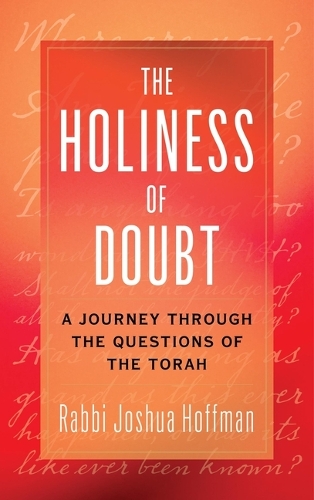
Книга The Holiness of Doubt: A Journey Through the Questions of the Torah
The Holiness of Doubt is a timely and essential contribution to the study of sacred Jewish texts. What does it mean for a book of faith for millions of people to be riddled with the uncertainties evoked by hundreds of questions? Rabbi Joshua Hoffman has chronicled the questions of the Torah and offers personal insights and the accumulated wisdom of interpretations, ancient and modern, to discover the meaning of questions and the holiness of doubt. This book offers the reader a chance to see the wisdom of the Torah refracted through its questions.
Divided according to the weekly Torah portions as traditionally studied in the Jewish community, this book explores the purpose of questions in the text and becomes a unique interpretation of the Torah on its own. There are also summaries for the portions which do not contain questions to explore what impact the absence of questions has on the Torah as a whole.
In confronting doubt, we gain a renewed permission to explore the deepest questions of our time. We can discover, like our ancestors dreamed, that the wisdom of the biblical tradition echoes eternal truth in every generation.
"
In this enlightening debut, rabbi Hoffman argues that the Torah can be better understood through questions the text itself poses, starting in Genesis with the snake’s provocation of Eve. The Torah’s questions are “more than literary devices,” Hoffman explains, and asking them is “as sacred... as expressing absolute faith.” God’s first question of Adam and Eve in the garden “Where are you?”—might seem odd coming from an “all-knowing” being, but his intention, Hoffman writes, was to inspire self-reflection and compel Adam and Eve to “take responsibility for [their] actions”; eventually their fear of God “will be transformed into confidence and loyalty.” Before God destroys Sodom and Gomorrah, his query “Shall I hide from Abraham what I am about to do?” demonstrated he was “grappling with the potential for goodness in the face of total wickedness,” and, as such, implicitly grants humans “permission to ask questions of God... because God models that behavior.” Ideal for synagogue study groups and curious believers, this offering advances an attitude toward doubt that’s freeing but purposeful textual questions exist in order to help readers “confront... uncertainty” and enrich their faith. Jewish readers eager to take their Torah study a step further should have a look.
" - Publishers Weekly