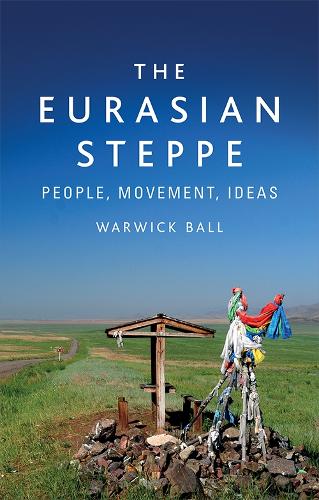
Книга The Eurasian Steppe: People, Movement, Ideas
A geographical area, not a political entity, the steppe connects the western and eastern parts of the Eurasian land mass. As such, it is always open, subject to constant movement between Asia and Europe. Warwick Ball tells the story of that movement from prehistory to the present. From nomadic peoples to conquering empires, from tales of Amazon women to art nouveau, and from golden grave goods to the formation of countries that still exist today, Ball shows how the steppe has continually shaped Europe’s destiny. Ultimately, he shows that the steppe and the movement of peoples across it are so crucial that they question the very idea of ‘Europe’ as a separate cultural and historical construct.
"Written for a general audience, Ball’s book nevertheless synthesises the latest archaeological research and historical debate on the steppe’s ancient and modern peoples, archaeological research on the steppe’s history, delving back into the deepest mists of time. The burgeoning community of esoteric archaeology and anthropology posters on Twitter will surely appreciate his summarising of the latest research on the origins of the Indo-Europeans, the fate of the Khazars and the birth and decline of the great Scythian kingdoms." - UnHerd
"Overall, The Eurasian Steppe: People, Movement, Ideas is a well-written and well-researched work on a vast topic. Its extended discussions on topics that have received less attention in other works in the field provide a unique and valuable contribution to our understanding of the history and impact of the Eurasian steppe." - International Journal of Russian Studies
"Of the many books on the Eurasian steppe written recently by historians and archaeologists, this is one of the most accessible, while remaining vast in its scope and detail. [...] It goes without saying that the book is well researched and represents a broad synthetic history of a vast geographical region by a person who wears his immense scholarship and erudition lightly. This is a book that is suitable for a popular audience as well as specialists." - BSOAS
"Ranging over territory from today’s Russia and Turkey to India and China, Ball charts the many waves of nomads who emerged from the Central Asian steppe. He explores such mysteries as the origins of the Indo-Europeans and the surprising role played by women … his answers may lead you to question what you thought you knew about past and present nationalist identities." - TLS Arts & books roundups: Summer books 2021
"[A] much-needed holistic overview that gives credit to a vibrant cultural phenomenon." - Minerva Magazine / ThePast.com
"This book is a major contribution to the rapidly emerging literature on the early origins of European culture against the wider backdrop of developments in the other empires and cultures that border the steppe." - European History Quarterly
"Well-written with a clear understanding of how life on the steppe works." - Amazon, Rutgers University
"The author’s distinct perspective comes through mainly in his choice of what material to include (in this case, that which is deemed relevant to Europe), but he does occasionally venture some thought-provoking opinions." - Caucasus Survey
"The Eurasian Steppe, by archaeologist and historian Warwick Ball, is a tour de force—and a magnificently illustrated one too—that takes us through the last few thousand years in the steppe that stretches from Mongolia to the Black Sea. Some of his histories are of almost forgotten peoples—Scythians, Sarmatians, Khazars—but the book frequently jolts you with its contemporary relevance, when he writes about Russians’ Eurasian heritage or the importance of Ukrainian grain for world markets." - Carnegie Europe