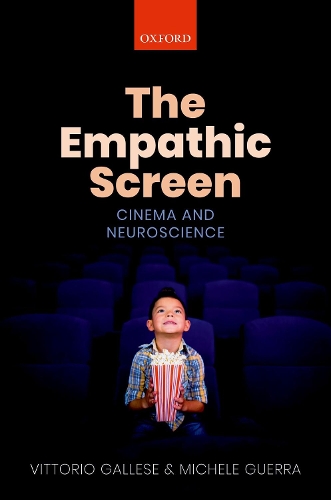
Книга The Empathic Screen: Cinema and Neuroscience
Why do people go to the movies? What does it mean to watch a movie? To what extent is the perceived fictional nature of movies different from our daily perception of the real world? We live in a time where the power of images has strongly invaded our everyday life, and we need new instruments and methods to better understand our relationship with the virtual worlds we inhabit every day. Taking cinema as the beginning of our relationship with the world of moving images, and cognitive neuroscience as a paradigm to understand how the images engage us, The Empathic Screen develops a new theory of film experience, exploring our brain-body interaction when engaging with and watching a film. In this book, film theory and neuroscience meet to shed new light on cinema masterpieces, such as The Shining, The Silence of the Lambs, and Toy Story, and explore the great directors from the classical period to the present. Taking a radical new approach to understanding the cinema, the book will be fascinating reading for cognitive scientists, neuroscientists, psychologists, philosophers, and film and media scholars.
"Gallese (a psychobiologist) and Guerra (a film theorist) use the apparatus of neuroscience to argue that movies "evoke" motor resonance in spectators. They support their argument by using the concepts of "mirror neurons" and "embodied simulation." The authors focus solely on camera movement, editing, and close-ups, ignoring montage sequences (e.g., the shower scene in Psycho) and sound (e.g., musical scores)." - J. Belton, emeritus, Rutgers, The State University of New Jersey, New Brunswick, Choice
"The Empathic Screen is devoted to examining how our natural tendency to simulate our fellow humans' actions affects the experience of watching (and hearing!) films. The authors attempt to build bridges between cognitivist, neuroscientific research, and philosophical traditions that tend to privilege "nurture" over "nature." Cognitivist-oriented film scholars will particularly enjoy the detailed analyses of film scenes. Gallese and Guerra show how these scenes trigger precognitive, embodied simulation through camera movements, close-ups of facial expressions and bodily experiences, editing, sound effects, or a combination of all these techniques. The book's discussion of experimental findings contains technical terminology and diagrams that the authors always summarize in accessible terms. This book represents the growing influence, not just of cognitive film scholarship, but of cognitive science in the humanities." - Charles Forceville, PhD, University of Amsterdam