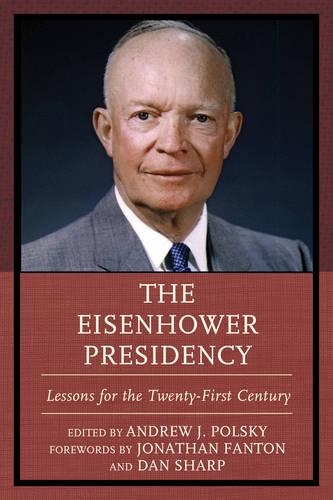
Книга The Eisenhower Presidency: Lessons for the Twenty-First Century
We are in the midst of a Dwight Eisenhower revival. Today pundits often look to Eisenhower as a model of how a president can govern across party lines and protect American interests globally without resorting too quickly to the use of force. Yet this mix of nostalgia and frustration with the current polarized state of American politics may mislead us. Eisenhower’s presidency has much to teach us today about how a president might avert crises and showdowns at home or abroad. But he governed under conditions so strikingly different from those a chief executive faces in the early 21st century that we need to question how much of his style could work in our own era. The chapters in this volume address the lessons we might draw from the Eisenhower experience for presidential leadership today. Although most of the authors find much to admire in the Eisenhower record, they express varying opinions on how applicable his approach would be for our own time. On one side, they appreciate his limited faith in the power of his words to move public opinion and his reluctance to turn to the use of force to solve international problems. On the other side, it was plain that Ike’s exercise of “hidden-hand” leadership (in Fred Greenstein’s evocative term) would not be possible in the modern media environment that makes Washington a giant fishbowl and instant revelation an acceptable norm. Both Eisenhower admirers and skeptics (and many of the authors are both) will find much in these essays to reinforce their preconceptions – and much that is unsettling. Eisenhower emerges as an effective but flawed leader. He was in many ways the right man for his time, but limited because he was also a man of his time.
"On leaving office, Dwight Eisenhower’s ranking as president was fairly low. Over time, his reputation has risen to the point that he is now regarded as one of the top ten presidents in US history. This collection of essays asks, 'What lessons can we learn from Ike’s example as a leader?' Editor Polsky's introduction acknowledges that 'to appropriate the past for use in the present is … an inherently problematic enterprise,' yet the authors of these essays believe there is much to learn from Ike’s example. Eisenhower viewed leadership as 'the ability to decide what is to be done, and then to get others to want to do it.' The essays cover a great deal of territory, including the nature of Ike’s conservatism, dealings with Congress, party leadership, and civil rights (which David A. Nichols maintains is a stronger record than has been acknowledged). Perhaps the strongest essay is Polsky’s conclusion reexamining the importance of political opportunity to leadership. A valuable and useful addition to the literature on the Eisenhower presidency that challenges some of the accepted wisdom about Eisenhower’s leadership. Summing Up: Highly recommended. Upper-division undergraduates and above." - CHOICE