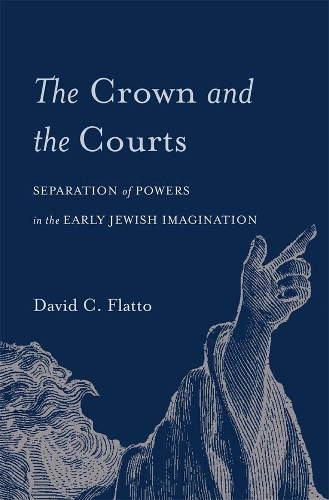
Книга The Crown and the Courts: Separation of Powers in the Early Jewish Imagination
A scholar of law and religion uncovers a surprising origin story behind the idea of the separation of powers.
The separation of powers is a bedrock of modern constitutionalism, but striking antecedents were developed centuries earlier, by Jewish scholars and rabbis of antiquity. Attending carefully to their seminal works and the historical milieu, David Flatto shows how a foundation of democratic rule was contemplated and justified long before liberal democracy was born.
During the formative Second Temple and early rabbinic eras (the fourth century BCE to the third century CE), Jewish thinkers had to confront the nature of legal authority from the standpoint of the disempowered. Jews struggled against the idea that a legal authority stemming from God could reside in the hands of an imperious ruler (even a hypothetical Judaic monarch). Instead scholars and rabbis argued that such authority lay with independent courts and the law itself. Over time, they proposed various permutations of this ideal. Many of these envisioned distinct juridical and political powers, with a supreme law demarcating the respective jurisdictions of each sphere. Flatto explores key Second Temple and rabbinic writings—the Qumran scrolls; the philosophy and history of Philo and Josephus; the Mishnah, Tosefta, Midrash, and Talmud—to uncover these transformative notions of governance.
The Crown and the Courts argues that by proclaiming the supremacy of law in the absence of power, postbiblical thinkers emphasized the centrality of law in the people’s covenant with God, helping to revitalize Jewish life and establish allegiance to legal order. These scholars proved not only creative but also prescient. Their profound ideas about the autonomy of law reverberate to this day.
"Thanks to the publication of this panoramic work, future scholars have a wealth of writing to consult in separating out the strands of thought in early Jewish imagination regarding legal–political philosophy." - Journal of the Church and State
"A work of consummate scholarship. It is essential reading for anyone wanting to know about the origins and nature of the separation of powers—a fundamental doctrine of modern constitutionalism, especially in the United States…Flatto demonstrates that the modern doctrine of separation of powers originated in certain biblical texts." - Journal of Law and Religion
"This is a profound and sharp study, which succeeds in revealing the complexity of the textual world of ancient Judaism and the multiplicity of views that existed there, while at the same time presenting a clear thesis about a common trend these various texts shared…An outstanding achievement." - Journal of the American Oriental Society
"[A] work of exceptional scholarship…We look to historical texts in view of our present concerns whether this is the status of nonhuman animals, the norming of human capacities, or constitutional theory. The challenge is to construct an interpretation of those texts that is animated by our interests while open to those expressed by them in their diversity, complexity, and even inconsistency. In this, The Crown and the Courts is a remarkable success." - Journal of Religion
"[Flatto’s] work will inspire some new directions in historical studies of the eras in question. His excellent readings, of Josephus and the tannaim in particular, are welcome additions to the scholarship on both." - Dead Sea Discoveries