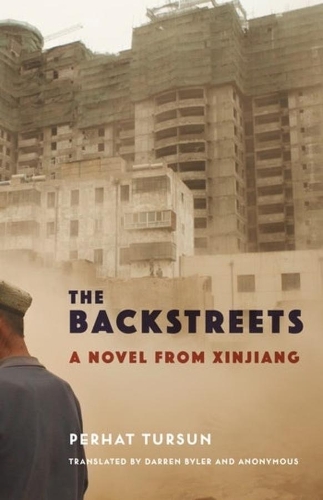
Книга The Backstreets: A Novel from Xinjiang
The Backstreets is an astonishing novel by a preeminent contemporary Uyghur author who was disappeared by the Chinese state. It follows an unnamed Uyghur man who comes to the impenetrable Chinese capital of Xinjiang after finding a temporary job in a government office. Seeking to escape the pain and poverty of the countryside, he finds only cold stares and rejection. He wanders the streets, accompanied by the bitter fog of winter pollution, reciting a monologue of numbers and odors, lust and loathing, memories and madness.
Perhat Tursun’s novel is a work of untrammeled literary creativity. His evocative prose recalls a vast array of canonical world writers—contemporary Chinese authors such as Mo Yan; the modernist images and rhythms of Camus, Dostoevsky, and Kafka; the serious yet absurdist dissection of the logic of racism in Ellison’s Invisible Man—while drawing deeply on Uyghur literary traditions and Sufi poetics and combining all these disparate influences into a style that is distinctly Perhat Tursun’s own. The Backstreets is a stark fable about urban isolation and social violence, dehumanization and the racialization of ethnicity. Yet its protagonist’s vivid recollections of maternal tenderness and first love reveal how memory and imagination offer profound forms of resilience. A translator’s introduction situates the novel in the political atmosphere that led to the disappearance of both the author and his work.
"Named a Best Book of 2022 by The New Yorker" - The New Yorker
"Close to a perfect work of art." - The Atlantic
"The Backstreets is an agonizing testimony to the anti-Uyghur policies and prejudices that led to [Tursun and the co-translator's] disappearances. It is also good writing of the sort that makes me feel like somebody has wrenched my head 90 degrees to the left: It's both clear and disorienting, an utterly new way of describing the world." - NPR Books
"Visceral and often disorientating, The Backstreets illustrates the painful effects of racism and exclusion. It is a strange and devastating novel, a portrait of what it means to become a second-class citizen in your homeland." - The Economist
"The Backstreets is undoubtedly an important political document, but it is, most of all, a significant addition to the canon of outsider literature." - Wall Street Journal
"Poignant and disturbing . . . Life as a persecuted minority colours the book, but Tursun breaks loose of narrow victimhood. The Backstreets is a compelling read in its own right." - The Spectator
"A startling literary document of urban alienation." - The New Yorker
"The Backstreets is a politically charged, emotional novel about the impacts of prejudice, industrial city life, and desolation on China’s Uyghur people. It is a major literary event that is honest in its portrayal of oppression." - Foreword Reviews, starred review
"[A] slight, sorrowful, tone-perfect novel . . . Tursun’s novel sings with a kind of lyrical despair and anomie, all rendered with sensual depth and persuasiveness." - Vancouver Sun
"There are many political – and perhaps ethical – reasons why The Backstreets deserves a wide readership. But above these should be an appreciation of its literary merits, not least of which are its sustained tone and imagery (well conveyed by Darren Byler and his co-translator)." - Times Literary Supplement
"One of The Millions' Most Anticipated Books of 2022" - The Millions
"Tursun, as rendered into English by Byler and Anonymous, writes with the ease and confidence of some of the greatest philosophical and absurdist writers of the twentieth century." - Asymptote
"A fierce and brave cry of moral repugnance." - The Arts Fuse
"A modernist masterpiece about life in China’s Muslim heartland." - Coda Story
"Tursun constructs a psychoanalytical auto-fictional biography of a city at the borders of the Chinese state, showing us the ordinary alienation and the mundane repression Uyghur bodies are subjected to in their everyday life. . .The existence of this text in English is a truly luminous event for world literature." - Cha: An Asian Literary Journal
"A remarkable work." - The Modern Novel
"[A]n excellent work and a pleasure to read. In a relatively short novel, the writer manages to express a people’s plight wrapped up in a story of a walk, and in the pollution that surrounds the walker." - Tony's Reading List
"[A] disturbing, socially vital work of literature..." - Words Without Borders
"[D]isorienting, disturbing, evoking a swirl of feelings in the reader." - Washington Independent Review of Books
"Given its author’s disappearance, The Backstreets will inevitably be received as a totem to the Uyghurs, first and foremost. It is that. But it is also more: a rare book that stands out because of the oppressive intensity of its narrative style, one reminiscent of the modernist writers (Dostoevsky, Camus, Freud) . . . At the same time, it carves out a distinctive voice that is uniquely bleak and beautiful." - The Guardian
"The Backstreets reads like a mash-up between Kafka and David Lynch." - The Book Beat
"A work of creative genius that takes as its theme the homelessness many Uyghurs feel as strangers in their own land." - The Nation
"This is a hugely important novel both as an excellent work of narrative art and as the encapsulation of the plight of an imperiled, suppressed ethnic group and its culture. Its translator, Darren Byler, should be loudly applauded for rendering this key text into lucid, well-judged English and bringing it to a global audience, as should his anonymous Uyghur co-translator." - World Literature Today
"One of my favourite novels of recent times." - Financial Times