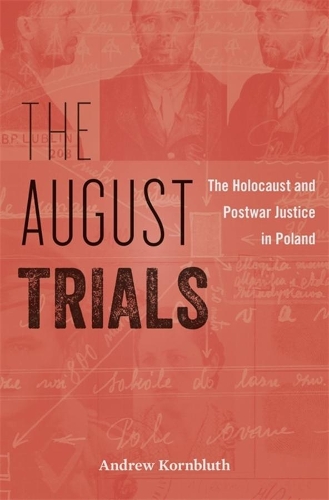
Книга The August Trials: The Holocaust and Postwar Justice in Poland
The first account of the August Trials, in which postwar Poland confronted the betrayal of Jewish citizens under Nazi rule but ended up fashioning an alibi for the past.
When six years of ferocious resistance to Nazi occupation came to an end in 1945, a devastated Poland could agree with its new Soviet rulers on little else beyond the need to punish German war criminals and their collaborators. Determined to root out the “many Cains among us,” as a Poznań newspaper editorial put it, Poland’s judicial reckoning spawned 32,000 trials and spanned more than a decade before being largely forgotten.
Andrew Kornbluth reconstructs the story of the August Trials, long dismissed as a Stalinist travesty, and discovers that they were in fact a scrupulous search for the truth. But as the process of retribution began to unearth evidence of enthusiastic local participation in the Holocaust, the hated government, traumatized populace, and fiercely independent judiciary all struggled to salvage a purely heroic vision of the past that could unify a nation recovering from massive upheaval. The trials became the crucible in which the Communist state and an unyielding society forged a foundational myth of modern Poland but left a lasting open wound in Polish-Jewish relations.
The August Trials draws striking parallels with incomplete postwar reckonings on both sides of the Iron Curtain, suggesting the extent to which ethnic cleansing and its abortive judicial accounting are part of a common European heritage. From Paris and The Hague to Warsaw and Kyiv, the law was made to serve many different purposes, even as it failed to secure the goal with which it is most closely associated: justice.
"Kornbluth’s forensic examination of August trials documents, only recently made available for scrutiny, confirms that the Jedwabne pogrom was not an isolated event…As a result of actions taken by Germans and Poles during this period, 90 per cent of Poland’s 3.5 million Jewish population was exterminated. Kornbluth’s detailing of cases makes difficult reading." - Jewish Chronicle
"Pioneering…Kornbluth examines the decree, its consequences and iterations, and its functioning in the complex realities of postwar Poland—both then and, by implication, today. Then, as now, the government largely sought to underscore crimes against Poles and to minimize crimes against Jews…Kornbluth shows brilliantly how, when those actually found guilty and sentenced for crimes against Jews challenged the verdicts, the description of facts would be totally changed between the original trial and the appeals trial, exonerating the perpetrators and strengthening the legend of Polish innocence." - Moment
"This is an excellent study and an important contribution to the ongoing discussion about collaboration, retribution, and justice in postwar Poland…A must read for anyone interested in the long-term consequences of crimes committed on the ‘margins of the Holocaust.’" - Antisemitism Studies
"Excellent…Complicating the dominant Polish myth of heroic resistance, The August Trials provides a rich, sobering account of how Poles perpetrated and then evaded responsibility for many heinous Holocaust crimes." - Canadian Journal of History
"A singularly important book, demonstrating how the opening of the archives after the fall of communism transformed our understanding of the past…an invaluable guide to a body of trial records in postwar Poland." - Journal of Modern History
"I cannot think of a book that provides a better understanding of the dominant contemporary Polish discourse, in which good deeds and heroism during the war are invariably attributed to the Polish nation, whereas adverse behavior is always attributed to ‘criminals,’ ‘individuals,’ or the ‘margins of society’…a riveting portrayal of nationalism in a smaller nation that, even today, remains uncertain of its identity and place within a complex and rapidly changing world — and, in consequence, is obsessed with promoting a sanitized version of national history." - Studies in Contemporary Jewry