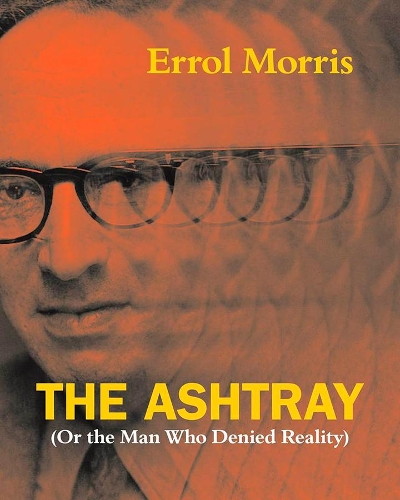
Книга The Ashtray: (Or the Man Who Denied Reality)
Filmmaker Errol Morris offers his perspective on the world and his powerful belief in the necessity of truth.
In 1972, philosopher of science Thomas Kuhn threw an ashtray at Errol Morris. This book is the result.
At the time, Morris was a graduate student. Now we know him as one of the most celebrated and restlessly probing filmmakers of our time, the creator of such classics of documentary investigation as The Thin Blue Line and The Fog of War. Kuhn, meanwhile, was—and, posthumously, remains—a star in his field, the author of The Structure of Scientific Revolutions, a landmark book that has sold well over a million copies and introduced the concept of “paradigm shifts” to the larger culture. And Morris thought the idea was bunk.
The Ashtray tells why—and in doing so, it makes a powerful case for Morris’s way of viewing the world, and the centrality to that view of a fundamental conception of the necessity of truth. “For me,” Morris writes, “truth is about the relationship between language and the world: a correspondence idea of truth.” He has no patience for philosophical systems that aim for internal coherence and disdain the world itself. Morris is after bigger game: he wants to establish as clearly as possible what we know and can say about the world, reality, history, our actions and interactions. It’s the fundamental desire that animates his filmmaking, whether he’s probing Robert McNamara about Vietnam or the oddball owner of a pet cemetery. Truth may be slippery, but that doesn’t mean we have to grease its path of escape through philosophical evasions. Rather, Morris argues powerfully, it is our duty to do everything we can to establish and support it.
In a time when truth feels ever more embattled, under siege from political lies and virtual lives alike, The Ashtray is a bracing reminder of its value, delivered by a figure who has, over decades, uniquely earned our trust through his commitment to truth. No Morris fan should miss it.
"“A scrappy continuation of Morris's disagreement with Kuhn and an explanation of why he thinks Kuhn’s ideas, which bear a certain resemblance to Berkeley’s, are so pernicious. . . . The Ashtray strikes me as an unlikely source for reaching a better understanding of Kuhn.; Morris dislikes him too much and can’t be trusted not to stack the deck against him. He ignores, for example, the excellent arguments against Whiggishness as a form of propaganda used to justify the historical dominance of Westerners over the rest of the world. But the book is a marvelous tool for the better understanding of Errol Morris, who is both a great artist and a fascinating individual in his own right.”
" - Slate
"Oscar-winning filmmaker Morris was once a graduate student under philosopher Thomas Kuhn, author of The Structure of Scientific Revolutions, and this intimate analysis of flaws in that 1962 treatise is driven by Morris's smart, conversational tone. . . . Throughout the heady discussion, Kuhn's cantankerous personality is revealed: he once threw an ashtray at Morris, who is responding--albeit 45 years later--by lobbing this combative tome into the academic and practical world."
- Publishers Weekly, starred review
"“The documentarian Errol Morris gives us The Ashtray, a semi-autobiographical tale of the supremely influential The Structure of Scientific Revolutions by Thomas S. Kuhn. A spellbinding intellectual adventure into the limits, fragility, and infirmity of human reason. Morris’s tale is picaresque. Anecdotes, cameos, interviews, historical digressions, sly side notes, and striking illustrations hang off a central spine that recounts critical episodes in the history of analytic philosophy.”
" - Boston Review
"“What is it about philosophers? A more fissiparous bunch it would be hard to find: if they aren’t threatening each other with pokers, they are flinging ashtrays at each other’s heads. . . . The Ashtray is passionate, polemical and defiantly written in chatty, accessible language with copious amusing footnotes. Frequently scabrous, Morris acknowledges that it could be seen as a vendetta, and freely admits that it is, as he views Kuhn’s idea of the social construction of knowledge as pernicious and disturbing. As befits a man whose life has been dedicated to documentary films, Morris sets great store by the existence of an objective truth, and this book is his passionate defence of that truth. . . . I found this all rather enjoyable. If you want an opinionated, impolite page-turner picking a fight with half of the modern philosophy of science, this is definitely the book for you.”
" - Fortean Times