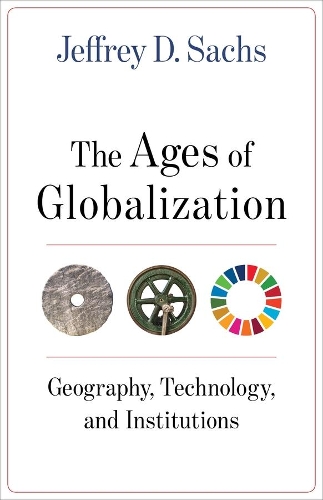
Книга The Ages of Globalization: Geography, Technology, and Institutions
Today’s most urgent problems are fundamentally global. They require nothing less than concerted, planetwide action if we are to secure a long-term future. But humanity’s story has always been on a global scale. In this book, Jeffrey D. Sachs, renowned economist and expert on sustainable development, turns to world history to shed light on how we can meet the challenges and opportunities of the twenty-first century.
Sachs takes readers through a series of seven distinct waves of technological and institutional change, starting with the original settling of the planet by early modern humans through long-distance migration and ending with reflections on today’s globalization. Along the way, he considers how the interplay of geography, technology, and institutions influenced the Neolithic revolution; the role of the horse in the emergence of empires; the spread of large land-based empires in the classical age; the rise of global empires after the opening of sea routes from Europe to Asia and the Americas; and the industrial age. The dynamics of these past waves, Sachs demonstrates, offer fresh perspective on the ongoing processes taking place in our own time—a globalization based on digital technologies. Sachs emphasizes the need for new methods of international governance and cooperation to prevent conflicts and to achieve economic, social, and environmental objectives aligned with sustainable development. The Ages of Globalization is a vital book for all readers aiming to make sense of our rapidly changing world.
"An authoritative account of our “shared,” increasingly interdependent human journey." - Kirkus Reviews
"This masterful history of the human experience of global interconnectedness begins in the Paleolithic Age and ends in today’s COVID-19 pandemic. Sachs makes a powerful case that the globalizing forces creating our increasingly interdependent world are deeply rooted in the human condition and that they are forces—for better and worse—that are here to stay." - Foreign Affairs
"Sachs wears his own extensive reading lightly. He’s a very clear writer, too, and the book has some lovely (colour) charts and maps." - The Enlightened Economist
"Sachs writes in simple, clean prose that most students and general readers should find accessible. This is no small feat considering the massiveness of the topics and the brevity of the book." - Middle Ground Journal
"A masterpiece in scope and depth, written in a lucid and accessible style—a pleasure to read." - Arab Studies Quarterly
"Collectively, Sachs lets us see that economics is not a human achievement but simply a social adaptation shaped
by natural selection for the effective management of resources. We have only mastered it." - Current Biology