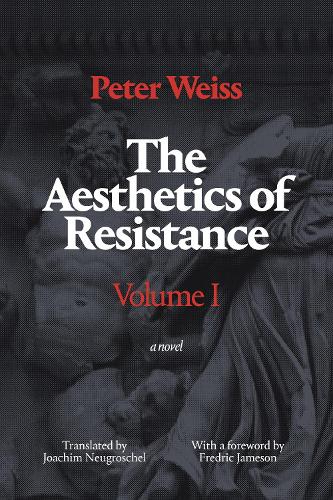
Книга The Aesthetics of Resistance, Volume I: A Novel
Regarded by many as one of the leading works of this century, this novel documents the resistance to fascism in Europe (and within Germany) during WWII.
A major literary event, the publication of this masterly translation makes one of the towering works of twentieth-century German literature available to English-speaking readers for the first time. The three-volume novel The Aesthetics of Resistance is the crowning achievement of Peter Weiss, the internationally renowned dramatist best known for his play Marat/Sade. The first volume, presented here, was initially published in Germany in 1975; the third and final volume appeared in 1981, just six months before Weiss’s death.
Spanning the period from the late 1930s to World War II, this historical novel dramatizes antifascist resistance and the rise and fall of proletarian political parties in Europe. Living in Berlin in 1937, the unnamed narrator and his peers—sixteen- and seventeen-year-old working-class students—seek ways to express their hatred for the Nazi regime. They meet in museums and galleries, and in their discussions they explore the affinity between political resistance and art, the connection at the heart of Weiss’s novel. Weiss suggests that meaning lies in embracing resistance, no matter how intense the oppression, and that we must look to art for new models of political action and social understanding. The novel includes extended meditations on paintings, sculpture, and literature. Moving from the Berlin underground to the front lines of the Spanish Civil War and on to other parts of Europe, the story teems with characters, almost all of whom are based on historical figures. The Aesthetics of Resistance is one of the truly great works of postwar German literature and an essential resource for understanding twentieth-century German history.
"For the right reader, The Aesthetics of Resistance offers unique rewards. The West’s literary memory of twentieth- century communism was largely shaped by ex- and anti-Communist writers like Arthur Koestler, Alexander Solzhenitsyn, Czesław Miłosz, and George Orwell, who saw it as inimical to spiritual and intellectual life. Weiss makes a passionate case to the contrary, arguing that for the poor and oppressed, communism offered a key to spiritual and intellectual realms from which they had been historically excluded. But he is also acutely aware that the humanistic, emancipatory communism of his dreams had a foe in the actual Soviet Communist Party, with its demand for total submission to an ever-changing ideological line. Balancing hope against reality, Weiss’s novel tries to carry out the critique-from-within he outlined in his 'Ten Working Points' essay." - New York Review of Books
"For the reader, The Aesthetics of Resistance, Volume I is as much an act of political memory and learning as it is for the novel’s narrator. . . . Cerebral and absorbing. . . ." - Popmatters
"The Aesthetics of Resistance writes those who have been culturally and historically excluded back into the story of their time and demands—as modernism does—that we learn to read in a new way. . . . The monuments of modernism today rise like Ozymandias’ statue in the sand: Ulysses, Proust, Beckett, Pound’s Cantos, The Making of Americans, The Waste Land. At last, we have an English translation of a work that stands alongside them." - Review of Contemporary Fiction
"At once a compeling tale of that resistance and an informative leftist history of the period it is situated in, Weiss’s Aesthetics of Resistance is not just his piéce de résistance, but a piéce de résistance of the twentieth century." - Counterpunch
"[O]ne of the most significant works of postwar German literature. . . . The novel feels like an endless soliloquy on a bare stage, but one that takes the audience on the most amazingly imaginative time-and-space journey, with the narrative perspective cutting like a movie director's camera from one intensely rendered visual detail to the next. . . . [E]xhilaratingly strange, compelling, and original. Readers who dare to enter this demanding verbal landscape will not come away empty-handed." - Bookforum