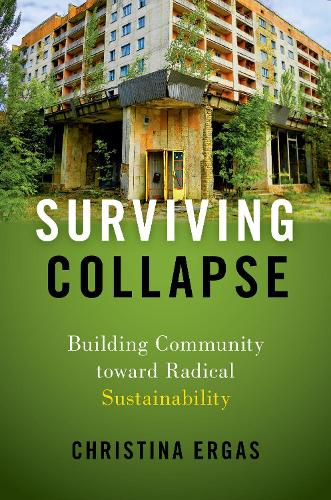
Книга Surviving Collapse: Building Community toward Radical Sustainability
As major environmental crises loom, Christina Ergas makes the argument in Surviving Collapse that one possible way forward is a radical sustainable development that turns the focus from monetary gain to social and ecological regeneration and transformation. Employing qualitative and cross-national comparative methods, Ergas examines two alternative, community-scale, socioecological models of development: the first is a grassroots urban ecovillage in the Pacific Northwest, United States, while the second is a government-subsidized, but cooperatively run, urban farm in Havana, Cuba. While neither are panaceas, they prioritize social and ecological efficiency and subsume economic rationality towards those ends. Featuring cases that not only allow us to synthesize their strengths but evaluate their weaknesses, Surviving Collapse reveals a multitude of varied paths toward reaching radical urban sustainability and empowers us all to imagine, and possibly build, more resilient futures.
"Christina Ergas's book Surviving Collapse appears at a timely moment and represents a significant shift in the climate change discussion." - John Bellamy Foster, University Of Oregon, Social Forces
"Libraries with reserve collections focusing on environmental philosophy, environmental sociology, and environmental politics should own this text." - K. M. Woosnam, University of Georgia, Choice Connect
"Christina Ergas's book Surviving Collapse...appears at a timely moment and represents a significant shift in the climate change discussion.... Considerable attention is given to such concepts as metabolic rifts, real utopias, the treadmill of production, ecological footprints, ecofeminism, climate denialism, and total liberation. Surviving Collapse was completed in 2020 prior to both the COVID-19 pandemic and the new nuclear threat presented by the war in Ukraine. This simply means, however, that today there are even more reasons to focus both in theory and practice on the creation of a society of radical sustainability, making Ergas's book more rather than less relevant." - Social Forces
"Ergas makes a strong case for 'radical sustainability'. Her book is an substantial overview of aspects of the urgent present debate." - Dr Greg Shepherd, Postgraduate researcher, Department of Geography and Environment, University of Adelaide