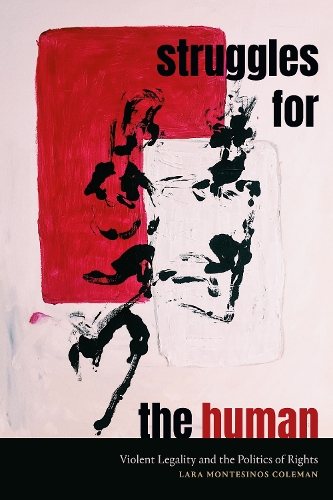
In Struggles for the Human, Lara Montesinos Coleman blends ethnography, political philosophy, and critical theory to reorient debates on human rights through attention to understandings of legality, ethics, and humanity in anticapitalist and decolonial struggle. Drawing on her extensive involvement with grassroots social movements in Colombia, Coleman observes that mainstream expressions of human rights have become counterparts to capitalist violence, even as this discourse disavows capitalism’s deadly implications. She rejects claims that human rights are inherently tied to capitalism, liberalism, or colonialism, instead showing how human rights can be used to combat these forces. Coleman demonstrates that social justice struggles that are rooted in marginalized communities’ lived experiences can reframe human rights in order to challenge oppressive power structures and offer a blueprint for constructing alternative political economies. By examining the practice of redefining human rights away from abstract universals and contextualizing them within concrete struggles for justice, Coleman reveals the transformative potential of human rights and invites readers to question and reshape dominant legal and ethical narratives.
"“In Struggles for the Human, Lara Montesinos Coleman brings together a blistering critique of mainstream human rights practices and a nuanced account of neoliberalism with a defense of the continued use of human rights by radical social movements. Coleman shows how human rights retain a disruptive potential and can contribute to the dismantling of capitalist structures of impunity. Breaking new ground in our thinking about rights, capitalist power, and emancipation, this is an indispensable book for all those interested in the politics of human rights, radical social movements, and political philosophy.”" - The Morals of the Market: Human Rights and the Rise of Neoliberalism
"Part philosophy and part political analysis, this interdisciplinary study explores critical legal studies, intellectual history, and international political economy to provide an eloquent, if at times complex, argument in favour of valorising human rights in a new way." - Latin American Review of Books