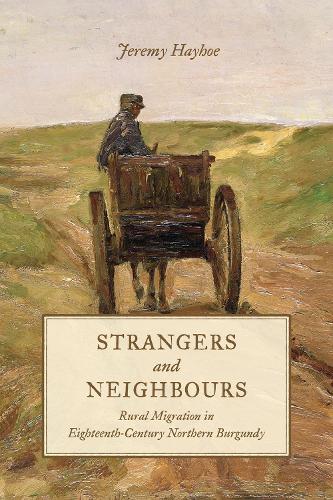
Книга Strangers and Neighbours: Rural Migration in Eighteenth-Century Northern Burgundy
"Thanks to thorough, resourceful archival research and an exemplary reading of documentary evidence, Jeremy Hayhoe has met thousands of rural people - ploughmen, wealthier farmers, agricultural workers, tramping artisans, pit-sawyers, servants - who changed residences in eighteenth-century Northern Burgundy. Which men and women were likely to move, why, how far, and for how long? How did the politics of power, seigneurial obligations, taxation, and access to communal resources influence economically based decisions to move? What kind of reception were they likely to receive in their new homes? How could they become integrated in new communities? This rich study of rural migration, fully informed by comparative experiences in other regions and countries, stresses continuities and changes, also offering some surprises in choices made by ordinary people." -- John Merriman, Charles Seymour Professor of History, Yale University "The demographic profile of early modern France has been forever reconfigured by Jeremy Hayhoe's methodologically innovative analysis of eighteenth-century Burgundy. What say we to a society in which outsiders made up half of the inhabitants, or one in which only 20 per cent of the people died in the parish of their birth? Hayhoe's dazzling array of sources shows us that local mobility rates have remained remarkably constant - five per cent per annum - from the seventeenth century to the twenty-first. He has created a remarkable new methodology for studying rural mobility in France and cast the sedentary village model into the dustbin of history. In so doing, he establishes a baseline for all future study. Few books published in this or any other year will have such far-reaching effects on the study of early modern France, and Europe. One can only wish that modern policymakers could learn from Strangers and Neighbours, so that they could understand today's European migration 'crisis' in its proper historical context." -- James Collins, Professor of History, Georgetown University
Though historians have come to acknowledge the mobility of rural populations in early modern Europe, few books demonstrate the intensity and importance of short-distance migrations as definitively as Strangers and Neighbours. Marshalling an incredible range of evidence that includes judicial records, tax records, parish registers, and the census of 1796, Jeremy Hayhoe reconstructs the migration profiles of more than 70,000 individuals from eighteenth-century northern Burgundy.
In this book, Hayhoe paints a picture of a surprisingly mobile and dynamic rural population. More than three quarters of villagers would move at least once in their lifetime; most of those who moved would do so more than once, in many cases staying only briefly in each community. Combining statistical analysis with an extensive discussion of witness depositions, he brings the experiences and motivations of these many migrants to life, creating a virtuoso reconceptualization of the rural demography of the ancien régime.
"
‘Hayhoe’s creativity in this book should not go unnoticed… His finding that no local policies prohibited migrations and that provincial authorities attempted to make them as orderly as possible highlights the use of history to create a better understanding of the present.’
" - Journal of Interdisciplinary History vol 47:04:2016"
"Hayhoe does more than simply document mobility…he explains why peasants moved to certain villages rather than others."
" - The American Historical Review, Volume 123, Issue 1, 1 February 2018"
"Jeremy Hayhoe’s excellent new study of rural migration in eighteenth-century northern Burgundy makes an important contribution towards renewing our understanding of the social life of the early modern French countryside…This is a model study, whose claims for a high degree of rural mobility in early modern France are convincing and important and whose broader claims about the consequences of this fact for rethinking social life and cultural identity are suggestively thought-provoking. Hayhoe’s book merits an important place in the historiography of mobility and early modern rural life."
" - University of Toronto Quarterly, vol 87 3, Summer 2018