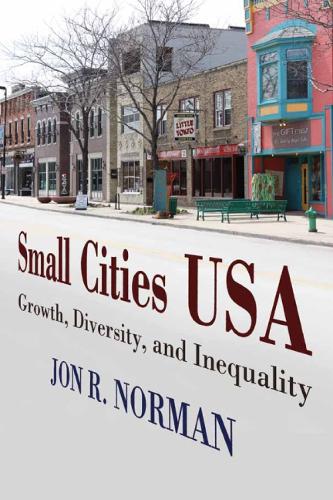
Книга Small Cities USA: Growth, Diversity, and Inequality
While journalists document the decline of small-town America and scholars describe the ascent of such global cities as New York and Los Angeles, the fates of little cities remain a mystery. What about places like Providence, Rhode Island; Green Bay, Wisconsin; Laredo, Texas; and Salinas, California—the smaller cities that constitute much of America’s urban landscape? In Small Cities USA, Jon R. Norman examines how such places have fared in the wake of the large-scale economic, demographic, and social changes that occurred in the latter part of the twentieth century.
Drawing on an assessment of eighty small cities between 1970 and 2000, Norman considers the factors that have altered the physical, social, and economic landscapes of such places. These cities are examined in relation to new patterns of immigration, shifts in the global economy, and changing residential preferences. Small Cities USA presents the first large-scale comparison of smaller cities over time in the United States, showing that small cities that have prospered over time have done so because of diverse populations and economies. These "glocal" cities, as Norman calls them, are doing well without necessarily growing into large metropolises.
"Norman presents a thought-provoking and important analysis of an urban world often overlooked by most social science researchers. Those seeking to understand the future of metropolitan America would be wise to read this book."
- University at Buffalo, SUNY
"Norman attempts to fill a gap in the study of US urban regions by focusing exclusively on what he labels 'small cities,' those with a population of between 100,000 and 200,000. The changes in smaller cities are the results of a myriad of social forces, including globalization, immigration and internal migration, educational attainment, ethnic diversity, and economic opportunity, inequality, and diversification, among other factors. Though many of these variables have no doubt contributed to changes in large US cities, Norman
argues that the way in which they have influenced the development of small cities is more nuanced. As a result, scholars must develop new conceptualizations and theories that better reflect those subtleties. This book is one contribution toward that end. Recommended."
- Choice
"In Small Cities USA, Norman surveys a largely overlooked segment of U.S. urban areas: cities that contain 100,000 to 200,000 people and that are not part of a larger metro area. Norman sees these places as an important—and neglected—piece of the urban puzzle."
- Planning
"Norman’s Small Cities USA takes an important step toward reminding urban scholars of the importance of smaller cities. It is a welcome alternative to the deluge of global cities research and offers a clear and concise point of entry for those wanting to explore this neglected side of urban studies."
- American Journal of Sociology