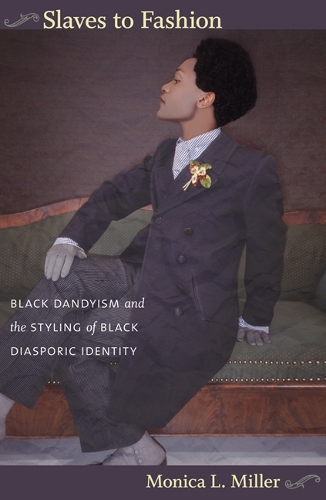
Книга Slaves to Fashion: Black Dandyism and the Styling of Black Diasporic Identity
Cultural and literary history of black dandyism from the 1700s to the 1960s
Slaves to Fashion is a pioneering cultural history of the black dandy, from his emergence in Enlightenment England to his contemporary incarnations in the cosmopolitan art worlds of London and New York. It is populated by sartorial impresarios such as Julius Soubise, a freed slave who sometimes wore diamond-buckled, red-heeled shoes as he circulated through the social scene of eighteenth-century London, and Yinka Shonibare, a prominent Afro-British artist who not only styles himself as a fop but also creates ironic commentaries on black dandyism in his work. Interpreting performances and representations of black dandyism in particular cultural settings and literary and visual texts, Monica L. Miller emphasizes the importance of sartorial style to black identity formation in the Atlantic diaspora.
Dandyism was initially imposed on black men in eighteenth-century England, as the Atlantic slave trade and an emerging culture of conspicuous consumption generated a vogue in dandified black servants. “Luxury slaves” tweaked and reworked their uniforms, and were soon known for their sartorial novelty and sometimes flamboyant personalities. Tracing the history of the black dandy forward to contemporary celebrity incarnations such as Andre 3000, Miller explains how black people became arbiters of style and how they have historically used the dandy’s signature tools—clothing, gesture, and wit—to break down limiting identity markers and propose new ways of fashioning political and social possibility in the black Atlantic world. With an aplomb worthy of her iconographic subject, she considers the black dandy in relation to nineteenth-century American literature and drama, W. E. B. Du Bois’s reflections on black masculinity and cultural nationalism, the modernist aesthetics of the Harlem Renaissance, and representations of black cosmopolitanism in contemporary visual art.
"“Encompassing the genres of drama, fiction, photography, film, and sculpture, Miller's study highlights the ways in which diaspora can be located in the image and the imagination of the body and its garments. . . . The value of Miller's text is in its historical range.”" - Modern Fiction Studies
"“Miller has performed a cultural excavation, sifting through fragments of visual and literary culture to trace a history of black style and assemble the first history of black dandyism. Her work deserves a place among the finer recent contributions to black performance studies. . . .”" - Callaloo
"“Miller’s study incites a much-needed dialogue between existing scholarship on the figure of the dandy—particularly its performative queering of modern narratives of masculinity and nationhood—and the legacies of imperialism and slavery that attest to the constant, if silent, presence of race and racializing discourse in those same narratives. . . . [A]n absorbing and timely study of the black dandy.”" - Comparative Literature
"“Monica L. Miller's book is the first of its kind: a lengthy written study of the history of black dandyism and the role that style has played in the politics and aesthetics of African and African American identity. She draws from literature, film, photography, print ads, and music to reveal the black dandy's underground cultural history and generate possibilities for the future. . . . [U]ncanny feats of scholarship that illustrate ways in which the figure of the black dandy has been an elephant-in-the-room — albeit a particularly well-dressed one.”" - San Francisco Bay Guardian