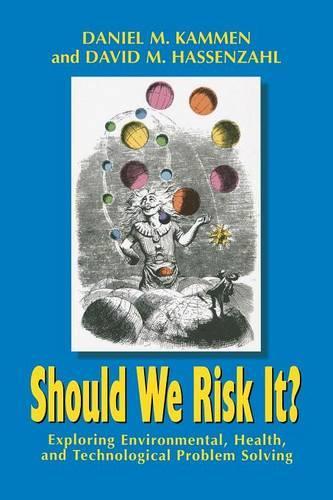
Книга Should We Risk It?: Exploring Environmental, Health, and Technological Problem Solving
Should We Risk It? is a timely and unique book. Its 'hands-on' approach to diverse risk problem-solving and decision-making methods fills a long-existing void. Using real-world problems, it introduces basic and more advanced methods in a clear, evenhanded, and thought-provoking manner. The more people who read it--both those already active in risk policy and those with a general interest--the better we as a society will be ready to cope with increasingly complex risk decisions. This book will improve both risk-based decisions and the associated public discourse. -- William Ruckelshaus, former Administrator of the U. S. Environmental Protection Agency This is a splendid book. It should be of interest to a wide range of students and professionals across the environmental and health sciences. -- John Harte, University of California, Berkeley; author of "Consider a Spherical Cow" Dan Kammen and David Hassenzahl have filled a long-standing need and have done it brilliantly. Their book provides the bridge between the technical tooks of risk analysis and the real world of health and environmental problems. Mastering the contents of this book should be a requirement for anyone--student or policy maker--who wants to understand risk analysis. -- J. Clarence "Terry" Davis, Director, Resources for the Future Center for Risk Management The authors have done a remarkable job of showing the common structures underlying the variety of risks that we face in our personal and professional lives. Moreover, their approach allows integrating the diverse forms of knowledge needed to address these complex problems. Readers will think differently after reading this book. -- Baruch Fischhoff, Professor of Social and Decision Sciences, Carnegie Mellon University This book will be very useful as a text in a risk-analysis class. It will also be a valuable reference for practitioners of risk assessment in industry, government, and consulting... The organization of the book is logical and effective. -- James K. Hammitt, Harvard University
How dangerous is smoking? What are the risks of nuclear power or of climate change? What are the chances of dying on an airplane? More importantly, how do we use this information once we have it? The demand for risk analysts who are able to answer such questions has grown exponentially in recent years. Yet programs to train these analysts have not kept pace. In this book, Daniel Kammen and David Hassenzahl address that problem. They draw together, organize, and seek to unify previously disparate theories and methodologies connected with risk analysis for health, environmental, and technological problems. They also provide a rich variety of case studies and worked problems, meeting the growing need for an up-to-date book suitable for teaching and individual learning. The specific problems addressed in the book include order-of-magnitude estimation, dose-response calculations, exposure assessment, extrapolations and forecasts based on experimental or natural data, modeling and the problems of complexity in models, fault-tree analysis, managing and estimating uncertainty, and social theories of risk and risk communication. The authors cover basic and intermediate statistics, as well as Monte Carlo methods, Bayesian analysis, and various techniques of uncertainty and forecast evaluation. The volume's unique approach will appeal to a wide range of people in environmental science and studies, health care, and engineering, as well as to policy makers confronted by the increasing number of decisions requiring risk and cost/benefit analysis. Should We Risk It? will become a standard text in courses involving risk and decision analysis and in courses of applied statistics with a focus on environmental and technological issues.