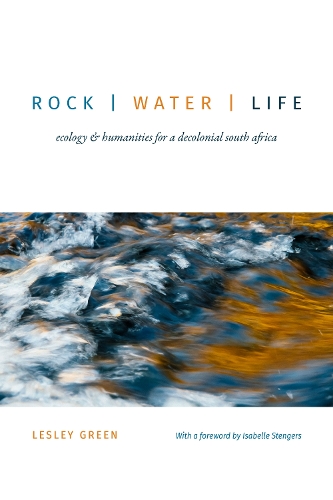
Книга Rock | Water | Life: Ecology and Humanities for a Decolonial South Africa
In Rock | Water | Life Lesley Green examines the interwoven realities of inequality, racism, colonialism, and environmental destruction in South Africa, calling for environmental research and governance to transition to an ecopolitical approach that could address South Africa's history of racial oppression and environmental exploitation. Green analyzes conflicting accounts of nature in environmental sciences that claim neutrality amid ongoing struggles for land restitution and environmental justice. Offering in-depth studies of environmental conflict in contemporary South Africa, Green addresses the history of contested water access in Cape Town; struggles over natural gas fracking in the Karoo; debates about decolonizing science; the potential for a politics of soil in the call for land restitution; urban baboon management; and the consequences of sending sewage to urban oceans.
"“So many writings on the ecological crisis remain grounded in the opposition between ‘the pragmatic cold analytical eye’ and ‘the romantic warm emotional heart,’ unaware that this binary is at the very heart of the crisis they are analyzing. This book is driven by a fresh participatory ethics that leaves this binary behind to introduce a caring relation that is analytically sharp and an affective engagement that is systematically incisive.”" - Is Racism an Environmental Threat?
"A thoughtful text on the intersections of inequality, racism, colonialism, and environmental destruction in South Africa. . . . [Green] provides a complex, nuanced contribution to the fields of environmental and decolonial studies. Highly recommended. Graduate students and faculty. General readers." - Choice
"“Lesley Green’s fascinating, timely, and lucidly argued Rock |Water |Life…is urgently needed and should be required reading for all environmental managers in South Africa and beyond.”" - Journal of Southern African Studies
"Lesley Green provides a richly layered response ot the growing outrage in South Africa against inherited colonial regimes of knowledge and its socioecological ravages. The book is a passionate manifesto of how decolonising one's claims to supreme knowledge is profoundly tied to one's material politics, indeed, how one relates to rock, water, and life." - Contributions to Indian Sociology
"“Poetic and complex, Rock/Water/Life evidences a love of South Africa’s environments and peoples. . . . As much political manifesto as scholarship, it calls upon us to rethink the questions we ask and create a more just ecopolitical system.”" - Journal of Global South Studies
"“Rock | Water | Life is a foray into the past armed with anti-colonial theorists and science and technology studies scholars as her way finders. . . . Green urgently searches for the tools that would allow for a new relationship with nature.”" - African Studies Review
"“The appearance of Rock | Water | Life is to be welcomed as South Africa confronts environmental and other challenges on an unprecedented scale.”" - Transactions of the Royal Society of South Africa
"“Lesley Green’s Rock | Water | Life is a remarkable text, and one that can be read in many ways. It is at once a deeply personal reflection on a planet in crisis, and a scholarly call to new ways of thinking. . . . Green herself is so conscious of what it at stake.”" - Postcolonial Studies
"“[Rock | Water | Life] makes utterly clear the crises we face (and already experience), if we do not undertake to step out of the mental prisons and all too real gulags bequeathed to us by modernity and colonialism. It is a compelling read, but the compulsion is not simply rhetorical just as the location is not simply South Africa—it is profoundly ethical wherever we are settled.”" - South African Journal of Science
"Green proposes an integrative way forward to deal with the misapplication of science. The book’s refreshing perspective includes drawing on important African postcolonial thinkers to encourage imaginative approaches to toxic landscapes. . . . The book includes important work on naming the racial divide in South African ecological issues, and the traumatic histories that led to this situation." - H-SAfrica, H-Net Reviews