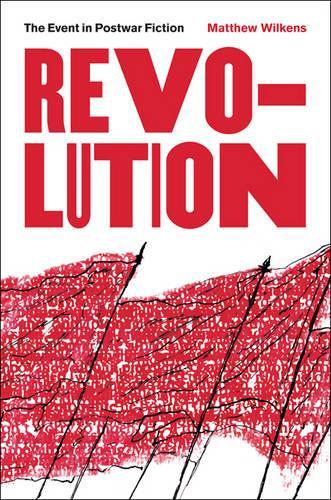
Книга Revolution: The Event in Postwar Fiction
A compelling and strikingly original account of the 1950s as a moment in literary history. Wilkens makes the case that-far from seeing this decade as a bland interregnum between the highs of modernism and postmodernism-we need to understand it as a moment in which the possibilities for literature are fascinatingly open. -- Andrew Hoberek, University of Missouri, author of The Twilight of the Middle Class: Post-World War II American Fiction and White-Collar Work Rarely does one happen upon a work of literary criticism that takes such incisive care in building its own conceptual foundations before beginning the work of interpretation. No surprise, then, that the reading of fifties literature arising therefrom is as sturdy, lucid, and elegant as it is fundamentally exciting and new. Wilkens transforms the nagging problem of the hinge between modernism and postmodernism into an occasion for literary historical inquiry of the most rewarding kind. -- Mark McGurl, Stanford University, author of The Program Era: Postwar Fiction and the Rise of Creative Writing
Socially, politically, and artistically, the 1950s make up an odd interlude between the first half of the twentieth century-still tied to the problems and orders of the Victorian era and Gilded Age-and the pervasive transformations of the later sixties. In Revolution, Matthew Wilkens argues that postwar fiction functions as a fascinating model of revolutionary change. Uniting literary criticism, cultural analysis, political theory, and science studies, Revolution reimagines the years after World War II as at once distinct from the decades surrounding them and part of a larger-scale series of rare, revolutionary moments stretching across centuries. Focusing on the odd mix of allegory, encyclopedism, and failure that characterizes fifties fiction, Wilkens examines a range of literature written during similar times of crisis, in the process engaging theoretical perspectives from Walter Benjamin and Fredric Jameson to Bruno Latour and Alain Badiou alongside readings of major novels by Ralph Ellison, William Gaddis, Doris Lessing, Jack Kerouac, Thomas Pynchon, and others. Revolution links the forces that shaped postwar fiction to the dynamics of revolutionary events in other eras and social domains. Like physicists at the turn of the twentieth century or the French peasantry of 1789, midcentury writers confronted a world that did not fit their existing models. Pressed to adapt but lacking any obvious alternative, their work became sprawling and figurative, accumulating unrelated details and reusing older forms to ambiguous new ends. While the imperatives of the postmodern eventually gave order to this chaos, Wilkens explains that the same forces are again at work in today's fracturing literary market.