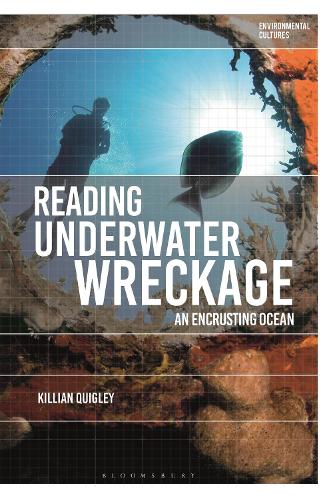
Книга Reading Underwater Wreckage: An Encrusting Ocean
Presents a novel and needed theoretical model for interpreting shipwrecks and other drowned fragments—the histories they tell, and the futures they presage—as junctures of artefact and ecofact, human remains and emergent ecologies.
Presenting a novel and needed theoretical model for interpreting shipwrecks and other drowned fragments—the histories they tell, and the futures they presage—as junctures of artefact and ecofact, human remains and emergent ecologies, this book puts the environmental humanities, and particularly multispecies studies, in close conversation with literary studies, history, and aesthetic theory. Earth’s oceans hold the remains of as many as three million shipwrecks, some thousands of years old. Instead of approaching shipwrecks as either artefacts or “ecofacts,” this book presents a third frame for understanding, one inspired by the material dynamism of sea-floor stuff. As they become encrusted by oceanic matter—some of it living, some inanimate—anthropic fragments participate in a distinctively submarine form of material relation. That relation comprises a wide, and sometimes incalculable, array of things, lives, times, and stories. Drawing from several centuries of literary, philosophical, and scientific encounters with encrustations—as well as from some of the innumerable encrusted “art-forms” that inhabit the sea floor— this book serves anyone in search of better ways to perceive, describe, and imagine submarine matters.
"This book's revelations will profoundly transform approaches to multispecies scholarship within the environmental humanities, cultural heritage studies, marine science, and beyond." - Ecozon@
"Reading Underwater Wreckage is a poignant and insightful entreaty to keep in mind that how we think and write, and conduct science, about wreckage is of paramount importance because wrecks are not things of the past. They are real things that impact real lives, then as now." - Journal of Maritime Archaeology
"This book is a remarkable confluence of material culture, environmental humanities, and literary studies – but at its heart is the work of the sea itself. Quigley invites us to sift through the de debris of the seafloor with new feelers, new eyes, new conceptual prosthetics. We are invited to rethink the sea as archive and artist, and to reconsider what sunken treasure augurs in a time of rapid cultural and environmental change." - Astrida Neimanis, University of British Columbia, Canada