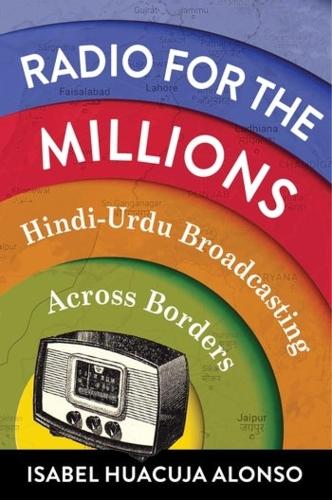
Книга Radio for the Millions: Hindi-Urdu Broadcasting Across Borders
Co-winner, 2023 AIPS Book Prize, American Institute of Pakistan Studies
Finalist, 2023 Richard Wall Memorial Award, Theatre Library Association
From news about World War II to the broadcasting of music from popular movies, radio played a crucial role in an increasingly divided South Asia for more than half a century. Radio for the Millions examines the history of Hindi-Urdu radio during the height of its popularity from the 1930s to the 1980s, showing how it created transnational communities of listeners.
Isabel Huacuja Alonso argues that despite British, Indian, and Pakistani politicians’ efforts to usurp the medium for state purposes, radio largely escaped their grasp. She demonstrates that the medium enabled listeners and broadcasters to resist the cultural, linguistic, and political agendas of the British colonial administration and the subsequent independent Indian and Pakistani governments. Rather than being merely a tool of nation building in South Asia, radio created affective links that defied state agendas, policies, and borders. It forged an enduring transnational soundscape, even after the 1947 Partition had made a united India a political impossibility.
Huacuja Alonso traces how people engaged with radio across news, music, and drama broadcasts, arguing for a more expansive definition of what it means to listen. She develops the concept of “radio resonance” to understand how radio relied on circuits of oral communication such as rumor and gossip and to account for the affective bonds this “talk” created. By analyzing Hindi film-song radio programs, she demonstrates how radio spurred new ways of listening to cinema. Drawing on a rich collection of sources, including newly recovered recordings, listeners’ letters to radio stations, original interviews with broadcasters, and archival documents from across three continents, Radio for the Millions rethinks assumptions about how the medium connects with audiences.
"Isabel Alonso provides a captivating history of radio that sits at the intersection of sound studies, cultural history, and the politics of nationalism in modern South Asia. In this virtuosic tale, we read about the policymakers, artists, singers, political figures, and poets who inhabited a broader transnational space in South Asia. . . This book will benefit an expansive community of readers, including academic communities in the disciplines of history and ethnomusicology and specifically readers interested in the cultural history of sound and music" - Not Even Past
"Skillfully and imaginatively highlights the place of [radio] in the broader historiographies of nation-building, language, and the public sphere." - The Book Review (India)
"An original and truly fascinating work." - H-Soz-Kult
"A fascinating story of the history of radio in South Asia." - The Citizen
"The book makes an important contribution, especially in unearthing and resurrecting liminal voices, which make up what I would call a kind of archaeology of Southasian media." - Himal Southasian
"This unique and engaging book offers a pleasurable reading experience while providing an urgently needed comprehensive and interdisciplinary history of South Asia." - Theatre Survey
"This volume provides a cogent introduction to early iterations of broadcasting on the subcontinent and tells the story of its shaping by wars, nationalism, and commerce." - Technology and Culture