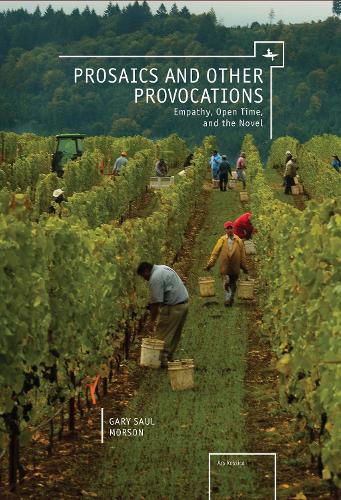
Книга Prosaics and Other Provocations: Empathy, Open Time, and the Novel
Gary Saul Morson’s ideas about life and literature have long inspired, annoyed, and provoked specialists and general readers. His work on “prosaics” (his coinage) argues that life’s defining events are not grand but ordinary, and that the world’s fundamental state is mess. Viewing time as a “field of possibilities,” he maintains that contingency and freedom are real. To represent open time, some masterpieces have developed an alternative to structure and require a “prosaics of process.” Morson’s curmudgeonly alter ego, Alicia Chudo, invents the discipline of “misanthropology,” which explores human vices from voyeurism to violence. Reflecting on his legendarily popular courses, Morson argues that what literature teaches better than anything else is empathy. Himself an aphorist, Morson offers a witty approach to literature’s shortest genres and to quotation in general.
"Morson, in a tremendous collection of pieces, extends his ongoing interest in what he calls 'prosaics'—basically, a way of attending to fictional prose that makes room for the messiness, the loose ends, and the improvised form that one finds in the great realist writers (for Morson, especially Dostoyevsky)." - "Favorite Books of 2013," The New Yorker
"“Read this book. While it is inspired by (and offers brief but illuminating studies of) the masterworks of Tolstoy and Dostoevsky, the volume’s relevance greatly transcends Russian literature, indeed it offers a corrective to much (one is tempted to say all) thought, whether that includes technological or economic history, animal or language speciation, or deconstructing the Old Testament. . . . Readers who cherish various theories of literature or even science itself will find Morson a contentious, amusing, and always-eloquent conversationalist, who argues for a “counter-tradition,” a life affirming perspective that opposes all-encompassing laws and patterns with details, processes, and especially our consciousness of the present moment with all its innumerable potentials.”" - The Russian Review, January 2015 (Vol. 74, No. 1)
"“Professors in undergraduate and especially graduate courses offered, and perhaps still offer, dire warnings against treating literary characters as though they somehow resembled real people or focusing on the writer’s intent in producing a work. Evaluation—declaring a work to be “good” or “bad”—was to be abjured. Morson cheerfully, even aggressively, violates these prohibitions. He is not afraid to single out those writers and works that he calls great, to consider the views of authors on literature, and to use novels as a means for probing ethical issues that individuals may face in real life.”" - Slavic and East European Journal, 58.3 (Fall 2014)