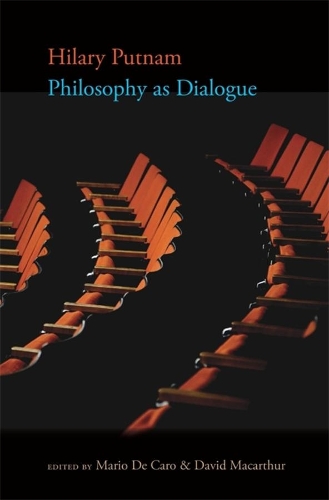
Книга Philosophy as Dialogue
A collection of Hilary Putnam’s stimulating, incisive responses to such varied and eminent thinkers as Richard Rorty, Jürgen Habermas, Noam Chomsky, Martha Nussbaum, W. V. Quine, Wilfrid Sellars, John McDowell, and Cornel West.
Hilary Putnam (1926–2016) was renowned—some would say infamous—for changing his philosophical positions over the course of his long and much-admired career. This collection of essays, the first of its kind, showcases how his ideas evolved as he wrestled with the work of his contemporaries.
Divided into five thematic sections, Philosophy as Dialogue begins with questions of language and formal logic, tracing Putnam’s reactions to the arguments of Wilfrid Sellars, Noam Chomsky, Charles Travis, and Tyler Burge. Next, it brings together Putnam’s responses to realists and antirealists, philosophers of science and of perception, followed by forays into pragmatism and skepticism. While Putnam devoted most of his efforts to logic, mathematics, and the philosophy of mind, he also took up issues in moral philosophy, politics, and religion. Here we read him in conversation with giants of these fields, including Martha Nussbaum, Jürgen Habermas, Elizabeth Anscombe, Cora Diamond, Richard Rorty, and Franz Rosenzweig. Finally, Philosophy as Dialogue presents Putnam’s deeply personal and largely unknown writing on philosophical method that reveals the influence of W. V. Quine, Michael Dummett, and Stanley Cavell on his work.
Once more, Mario De Caro and David Macarthur have presented and introduced a choice selection of Hilary Putnam’s writings that will change the way he is understood. Most of all, these thirty-six replies and responses to his contemporaries showcase the extraordinary—perhaps even unparalleled—breadth of his work, and his capacity to engage deeply with seemingly every mode of philosophy.
"The striking variety of essays testify to Putnam’s wide-ranging intellect, and his penetrating responses to fellow philosophers exemplify his belief that one of the purposes of philosophy is to ‘encounter texts which anger, provoke, inspire, transform, repulse, or all of these at once.’ Scholars will appreciate this edifying addition to Putnam’s oeuvre." - Publishers Weekly
"This volume has a larger metaphilosophical goal: to make philosophy (explicitly) dialogical again. Although the fact that Putnam ‘changed his mind’ several times during his career is often cited as a quirky idiosyncrasy, it should rather be seen as an example to follow: ‘philosophers should never assume that they have reached the final truth on a topic of philosophical interest and should always be open to alternative viewpoints’…Changing one’s mind in philosophy should be the rule, not the exception." - International Journal of Philosophical Studies