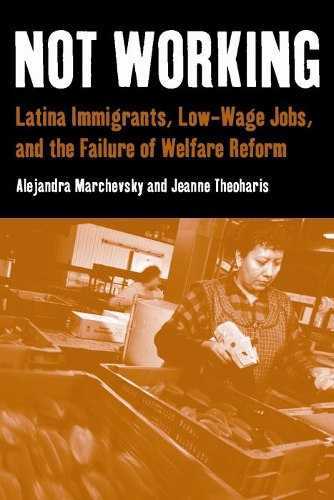
Not Working chronicles the devastating effects of the 1996 welfare reform legislation that ended welfare as we know it. For those who now receive public assistance, “work” means pleading with supervisors for full-time hours, juggling ever-changing work schedules, and shuffling between dead-end jobs that leave one physically and psychically exhausted.
Through vivid story-telling and pointed analysis, Not Working profiles the day-to-day struggles of Mexican immigrant women in the Los Angeles area, showing the increased vulnerability they face in the welfare office and labor market. The new “work first” policies now enacted impose time limits and mandate work requirements for those receiving public assistance, yet fail to offer real job training or needed childcare options, ultimately causing many families to fall deeper below the poverty line.
Not Working shows that the new “welfare-to-work” regime has produced tremendous instability and insecurity for these women and their children. Moreover, the authors argue that the new politics of welfare enable greater infringements of rights and liberty for many of America's most vulnerable and constitute a crucial component of the broader assault on American citizenship. In short, the new welfare is not working.
"This is a scholarly, professional critique of social science research paradigms generally, and poverty knowledge industry and associated applied policy research in particular:" - Choice: Highly recommended
"With this book, Marchevsky and Theoharis make a distinct contribution to the welfare reform debate by addressing a topic that has received less attention in the literature, namely how welfare reforms have impacted immigrant. Not Working is particularly timely as immigrants become more visible as they move to less traditional U.S. regions to find work and the immigration debate rages." - Journal of Sociology and Social Welfare