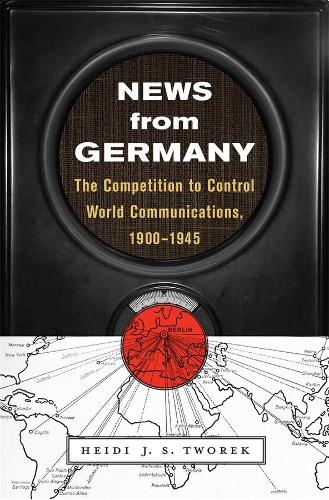
Книга News from Germany: The Competition to Control World Communications, 1900–1945
Winner of the Barclay Book Prize, German Studies Association
Winner of the Gomory Prize in Business History, American Historical Association and the Alfred P. Sloan Foundation
Winner of the Fraenkel Prize, Wiener Library for the Study of Holocaust and Genocide
Honorable Mention, European Studies Book Award, Council for European Studies
To control information is to control the world. This innovative history reveals how, across two devastating wars, Germany attempted to build a powerful communication empire—and how the Nazis manipulated the news to rise to dominance in Europe and further their global agenda.
Information warfare may seem like a new feature of our contemporary digital world. But it was just as crucial a century ago, when the great powers competed to control and expand their empires. In News from Germany, Heidi Tworek uncovers how Germans fought to regulate information at home and used the innovation of wireless technology to magnify their power abroad.
Tworek reveals how for nearly fifty years, across three different political regimes, Germany tried to control world communications—and nearly succeeded. From the turn of the twentieth century, German political and business elites worried that their British and French rivals dominated global news networks. Many Germans even blamed foreign media for Germany’s defeat in World War I. The key to the British and French advantage was their news agencies—companies whose power over the content and distribution of news was arguably greater than that wielded by Google or Facebook today. Communications networks became a crucial battleground for interwar domestic democracy and international influence everywhere from Latin America to East Asia. Imperial leaders, and their Weimar and Nazi successors, nurtured wireless technology to make news from Germany a major source of information across the globe. The Nazi mastery of global propaganda by the 1930s was built on decades of Germany’s obsession with the news.
News from Germany is not a story about Germany alone. It reveals how news became a form of international power and how communications changed the course of history.
"Tworek reveals how officials in the Weimar government, believing they were acting in the best interests of democracy, created structures to oversee and regulate news supply. This led to policies, such as restricting political advocacy from the radio, intended to forestall inflaming partisan passions. Ironically, it was the state’s tight control over the news supply that allowed the Nazis to swiftly take over the country’s communications channels and remake them to serve their interests." - Washington Post
"A timely book: if we are concerned about governments manipulating the news across borders in the present, we need to understand how they did this in the past…News From Germany provides much-needed historical depth to the current debate about media power and the age of ‘surveillance capitalism.’ No one would suspect today’s media and internet giants of following anything like the Third Reich’s murderous, totalitarian strategies. Yet Tworek’s well-researched analysis has contemporary resonance. The Nazis’ priority, Goebbels explained, was not to indoctrinate, but to entertain the masses—and gain as much information about them as possible." - Financial Times
"Riveting…From 1900 to 1945, reveals historian Heidi Tworek, Germany strove mightily to achieve world power through news agencies, spoken radio and wireless, urged on by figures from Weimar Republic foreign minister Gustav Stresemann to Nazi propagandist Joseph Goebbels. A chillingly timely cautionary tale, demonstrating that once elites destroy democratic institutions, a free press cannot prevent further disintegration." - Nature
"A masterpiece of erudition, it represents a major contribution to both our understanding of the role of the media in history and to the history of Germany in the first half of the twentieth century." - Journal of Modern History
"Engaging and timely…Tworek challenges oversimplified and idealistic perceptions of the historical purpose, values, and organization of (liberal democratic) media by revealing the complex infrastructure of information gathering and dissemination that has today, distressingly, been reduced to the problem defined as ‘fake news’…breaks new ground in historical media studies." - Technology and Culture