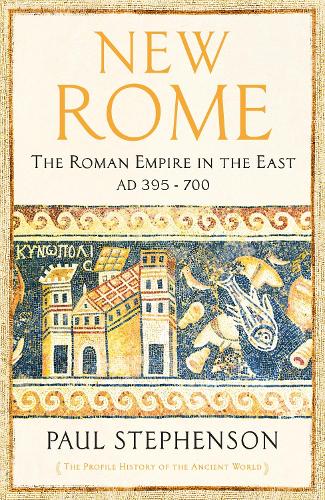
Three hundred action-packed years of Roman history, encompassing the fall of Rome and the rise of a new empire in the East
'Fascinating ... illuminating ... Stephenson examines ordinary life, painting a vivid and intriguing picture.'
The Times
Long before Rome fell to the Ostrogoths in AD 476, a new city had risen to take its place as the beating heart of a late antique empire, the glittering Constantinople: New Rome.
In this magisterial work, Professor Paul Stephenson charts the centuries surrounding this epic shift of power. He traces the cultural, social and political forces that led to the empire being ruled from a city straddling Europe and Asia, placing all into a rich natural and environmental context informed by the latest scientific research.
Blending narrative with analysis, he shows how the city and empire of New Rome survived countless attacks and the rise of Islam. By the end, the wide world of linked cities had changed into a world founded on new ideas about government and God, art and war, and the very future of a Christian empire: Byzantium.
"Brings the world of New Rome alive with exceptional learning and a magnificent openness to modern scientific methods that breathe life into conventional narratives of political and social history." - The New York Review of Books
"A wonderfully sharp eye for data and detail. ... I have been quoting passages and surprising facts to everyone around me ever since putting it down." - The Critic
"Conventional histories of the last days of the Roman Empire will no longer suffice after you read this book." - Byzantine Matters
"The most compelling fusion yet of narrative history with the recent findings of environmental research and scientific data." - Romanland
"A new book from the historian Paul Stephenson centers on the Byzantine world in the period 395-700 A.D., combining modern scientific methods with traditional history to explain which parts of Rome migrated east and what became of them." - The New Criterion
"Stephenson explores evidence of climate change caused by volcanic eruption and earthquakes not so much as an engine for political change as a permanent threat to the human environment ... [he] draws with great skill and an eye for detail on the stories embedded in surviving papyri, on laws, and on saints' lives." - Los Angeles Review of Books