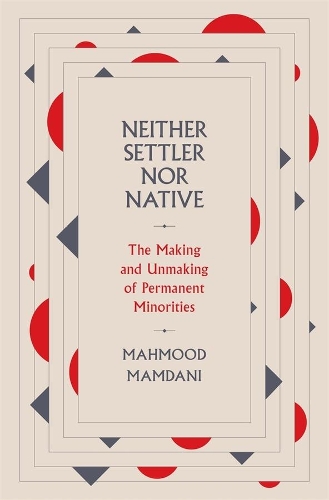
Книга Neither Settler nor Native: The Making and Unmaking of Permanent Minorities
Shortlisted for the British Academy Book Prize for Global Cultural Understanding
Making the radical argument that the nation-state was born of colonialism, this book calls us to rethink political violence and reimagine political community beyond majorities and minorities.
In this genealogy of political modernity, Mahmood Mamdani argues that the nation-state and the colonial state created each other. In case after case around the globe—from the New World to South Africa, Israel to Germany to Sudan—the colonial state and the nation-state have been mutually constructed through the politicization of a religious or ethnic majority at the expense of an equally manufactured minority.
The model emerged in North America, where genocide and internment on reservations created both a permanent native underclass and the physical and ideological spaces in which new immigrant identities crystallized as a settler nation. In Europe, this template would be used by the Nazis to address the Jewish Question, and after the fall of the Third Reich, by the Allies to redraw the boundaries of Eastern Europe’s nation-states, cleansing them of their minorities. After Nuremberg the template was used to preserve the idea of the Jews as a separate nation. By establishing Israel through the minoritization of Palestinian Arabs, Zionist settlers followed the North American example. The result has been another cycle of violence.
Neither Settler nor Native offers a vision for arresting this historical process. Mamdani rejects the “criminal” solution attempted at Nuremberg, which held individual perpetrators responsible without questioning Nazism as a political project and thus the violence of the nation-state itself. Instead, political violence demands political solutions: not criminal justice for perpetrators but a rethinking of the political community for all survivors—victims, perpetrators, bystanders, beneficiaries—based on common residence and the commitment to build a common future without the permanent political identities of settler and native. Mamdani points to the anti-apartheid struggle in South Africa as an unfinished project, seeking a state without a nation.
"Demonstrates how a broad rethinking of political issues becomes possible when Western ideals and practices are examined from the vantage point of Asia and Africa." - New York Review of Books
"Argues for a wider, political approach to understanding historical violence rather than an individual, criminal one. Mamdani examines everything from the treatment of Native Americans to Nazism to South African apartheid. It is a complex and at times painful book, but history is often complex and painful, and trying to understand it is one of our few real paths to progress." - New York Times
"Over half a century, Mamdani has carved out a reputation as a forceful and articulate critic of political modernity’s supposed peace-bringing qualities…Neither Settler nor Native is [his] most comprehensive exploration yet of the subject of majority–minority relations. In a comparative analysis of five countries…he locates the origin story of contemporary postcolonial political violence far back in history." - The Baffler
"Mamdani makes a compelling case… Although the book’s scope is ambitious…it has a clear starting point: the invention of indirect rule as a technique of modern colonial governance…Mamdani draws on the details of his case studies to formulate some broad lessons for decolonizing politics today—most importantly, disaggregating the nation from the state and creating more inclusive forms of democratic politics in the wake of identity-based strife." - Boston Review
"Provocative, elegantly written…with the aim of understanding the sources of the extreme violence that has plagued so many postcolonial societies." - New York Review of Books
"An urgent intervention in contemporary politics. In a searing critique of the nation-state, Mamdani persuasively argues that there will be no decolonization, no democracy, no peace until we de-link the association between the ‘nation’ and state power." - The Wire
"Mamdani [is] one of the most perceptive and savviest analysts of postcolonial African history…A major achievement. A veritable testimony to the strength and resources of political thought that is a boon to his students and admirers, and to every other reader not enchanted by the discourses of the powers-that-be." - Muslim World Book Review