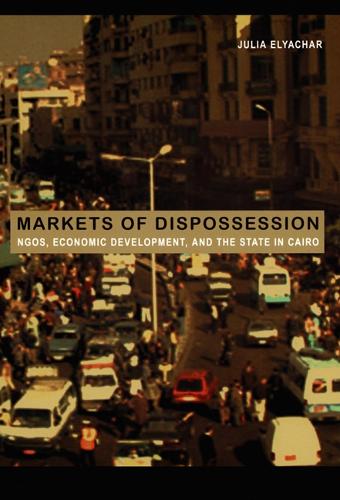
Книга Markets of Dispossession: NGOs, Economic Development, and the State in Cairo
A case study of economic development in Cairo that sheds light on issues of agency and empowerment in the age of neoliberal globalization
What happens when the market tries to help the poor? In many parts of the world today, neoliberal development programs are offering ordinary people the tools of free enterprise as the means to well-being and empowerment. Schemes to transform the poor into small-scale entrepreneurs promise them the benefits of the market and access to the rewards of globalization. Markets of Dispossession is a theoretically sophisticated and sobering account of the consequences of these initiatives.
Julia Elyachar studied the efforts of bankers, social scientists, ngo members, development workers, and state officials to turn the craftsmen and unemployed youth of Cairo into the vanguard of a new market society based on microenterprise. She considers these efforts in relation to the alternative notions of economic success held by craftsmen in Cairo, in which short-term financial profit is not always highly valued. Through her careful ethnography of workshop life, Elyachar explains how the traditional market practices of craftsmen are among the most vibrant modes of market life in Egypt. Long condemned as backward, these existing market practices have been seized on by social scientists and development institutions as the raw materials for experiments in “free market” expansion. Elyachar argues that the new economic value accorded to the cultural resources and social networks of the poor has fueled a broader process leading to their economic, social, and cultural dispossession.
"“[A] masterful description and sophisticated interpretation of the transformation of the social, cultural, and political economy of urban Egypt since the early 1990s. . . . Elyachar has written a book that is essential reading for anyone concerned with development, Egypt and the Arab World, and the dangers of ideologically motivated interference by foreign social scientists and other experts in local economies and societies.”
" - American Ethnologist
"“Elyachar has produced a work rich in fine ethnographic detail and driven by important theoretical insights into the workings of market, the anthropology of value, the play of power in society, and the social consequences of development strategies. This is a brilliant study on many levels. . . . This work is a tour-de-force of critical analysis and ethnographic exposition. It sets new standards for the study of programmatic economic development, the ethnography of craft and small-scale production, and the cultural consequences and human costs of structural adjustment.”" - Social Anthropology