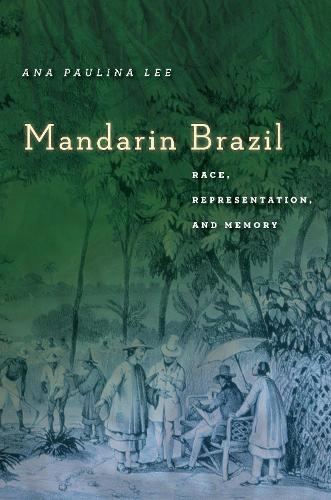
Книга Mandarin Brazil: Race, Representation, and Memory
In Mandarin Brazil, Ana Paulina Lee explores the centrality of Chinese exclusion to the Brazilian nation-building project, tracing the role of cultural representation in producing racialized national categories. Lee considers depictions of Chineseness in Brazilian popular music, literature, and visual culture, as well as archival documents and Brazilian and Qing dynasty diplomatic correspondence about opening trade and immigration routes between Brazil and China. In so doing, she reveals how Asian racialization helped to shape Brazil's image as a racial democracy.
Mandarin Brazil begins during the second half of the nineteenth century, during the transitional period when enslaved labor became unfree labor—an era when black slavery shifted to "yellow labor" and racial anxieties surged. Lee asks how colonial paradigms of racial labor became a part of Brazil's nation-building project, which prioritized "whitening," a fundamentally white supremacist ideology that intertwined the colonial racial caste system with new immigration labor schemes. By considering why Chinese laborers were excluded from Brazilian nation-building efforts while Japanese migrants were welcomed, Lee interrogates how Chinese and Japanese imperial ambitions and Asian ethnic supremacy reinforced Brazil's whitening project. Mandarin Brazil contributes to a new conversation in Latin American and Asian American cultural studies, one that considers Asian diasporic histories and racial formation across the Americas.
"Mandarin Brazil is an excellent example of the New Latin American Ethnic Studies that has developed over the last decade. Lee's book demonstrates that ideas about immigrants are critical to the formation of Brazilian national identity and that Chinese racialization cannot be separated from broader social, economic, and cultural relations that emerged from a heritage of slavery and an elite desire for 'whiteness.'" - Emory University
"A richly textured and meticulously researched study of Chinese racialization in Brazil. Lee elegantly weaves together the 'minor' fragments of Chinese cultural representation to analyze the shifting meanings of Chinese personhood in Brazil against the broader context of global race-making that arose with European colonial expansion and that continued in nation-building projects. A must-read for anyone studying Brazil, Latin America, Chinese diaspora, and Asians in the Americas." - University of California at Berkeley
"Mandarin Brazil is a thought-provoking work of scholarship relevant to a variety of fields: Brazilian history and culture, Asian American studies, migration history, the history of Portuguese imperialism, post-colonial studies, Lusophone literatures, and others....For historians, this work also sheds light on the stimulating possibilities of often-overlooked primary sources, such as songs, in transnational and global history studies." - Reviews in History
"Mandarin Brazil is an edifying work...Bridging the historical and culture gap between Brazil and Asia, the book weaves together a mélange of complex racial and ethnic identities that were instrumental to the development of modern Brazil....[A] great addition to the growing historiography of the Asian-Latino Studies." - Brasiliana
"The interpretative force of Ana Paulina Lee's study of aspects of Chineseness and circumoceanic memory, with a spatial focus on Brazil, is a solid and relevant incentive for exponential growth of research that can strengthen Brazil-China relations. Although there are no consistent historical ties that bring the two countries together, and both are still largely unknown to each other, there are still traces (reconstructed, resignified, and reinvented in time) of old representations and old circumoceanic memories that need to be reckoned with." - Luso-Brazilian Review
"Mandarin Brazil makes major contributions to understanding the politics of Asians and Asianness in the Americas." - Journal of Asian Studies