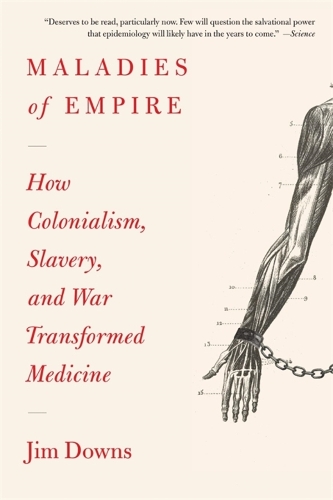
Книга Maladies of Empire: How Colonialism, Slavery, and War Transformed Medicine
“Maladies of Empire has a captivating writing style, is exhaustively researched, and is persuasive in argumentation. Jim Downs has written a game-changing book.”—Deirdre Cooper Owens, author of Medical Bondage: Race, Gender, and the Origins of American Gynecology
“An eye-popping study of the history of infectious diseases, how they spread, and especially how they have been thwarted by experimentation on the bodies of soldiers, slaves, and colonial subjects…a timely, brilliant book about some of the brutal ironies in the story of medical progress.”—David W. Blight, author of Frederick Douglass
“Brilliant…Jim Downs uncovers the origins of epidemiology in slavery, colonialism, and war. A most original global history, this book is required reading for historians, medical researchers, and really anyone interested in the origins of modern medicine.”—Sven Beckert, author of Empire of Cotton
“[Sheds] light on the violent foundations of disease control interventions and public health initiatives [and] implores us to address their inequities in the present.”—Ragav Kishore, The Lancet
Most stories of medical progress come with ready-made heroes. John Snow traced the origins of London’s 1854 cholera outbreak to a water pump, leading to the birth of epidemiology. Florence Nightingale’s care of soldiers in the Crimean War revolutionized medical hygiene. Yet focusing on individual innovators ignores many of the darker, unacknowledged sources of medical knowledge.
Reexamining the foundations of modern medicine, Jim Downs shows that the study of infectious disease depended crucially on the unrecognized contributions of conscripted soldiers, enslaved people, and subjects of empire. From Africa and India to the Americas, plantations, slave ships, and battlefields were the laboratories where physicians came to understand the spread of disease. Boldly argued and urgently relevant, Maladies of Empire gives a long overdue account of the true price of medical progress.
"For those of us looking warily toward future epidemics, this book draws our attention to oft-forgotten sources of medical knowledge…Deserves to be read, particularly now. Few will question the salvational power that epidemiology will likely have in the years to come." - Science
"Downs has now given global context to nineteenth-century advances in medicine and public health, beyond the dominant histories rooted in Western Europe and the ancient world. In Maladies of Empire, he centers slave ships, people living in colonized countries, prisoners, and wars in the narrative of medical discovery, at the foundation of epidemiology…He recovers lost and untold stories and makes visible things that need to be seen." - Nature
"[A] searching reappraisal of the origins of epidemiology…Those who lead epidemiology and public health today should read Maladies of Empire. They might wish to reflect on the origins of their discipline, the histories they choose to ignore, the myths they prefer to propagate. And they might wish to consider the debt they—we—owe to those who were, and in some cases still are, abused, mistreated, and manipulated in the name of public health." - The Lancet
"Exposes how doctors with few clues made concerted efforts to track and understand deadly epidemics at a time when the colonialist enterprise was aggressively remaking the world…[Downs] fleshes out a crucial part of a larger tapestry to help explain the onset of racial segregation in the United States. The people whose experiences he tries to recover ‘appear only as fragments’ in the historical record but they impart a crucial dimension that remains utterly germane to the present." - Los Angeles Review of Books
"Connects imperialism, enslavement, and warfare to argue that it is at the intersection of these processes that we can trace the beginnings of modern epidemiological thinking…Not only does such a narrative shed light on the violent foundations of disease control interventions and public health initiatives, but it also implores us to address their inequities in the present. At a time when low-income and middle-income countries struggle for access to vaccines in the COVID-19 pandemic, such an endeavor could not be more urgent." - The Lancet
"A compelling read for everyone interested in the connection between slavery, colonialism, and war and the advancement of medical knowledge." - International Social Science Review
"Relevant reading for historians in a wide variety of fields but especially healthcare historians. By recognizing the experience of the enslaved poor and military in the evolution of medicine, it gives in part a voice to those who usually appear as a statistic while the clinicians are lauded." - British Society for the History of Medicine
"Using historiographical techniques developed by Black feminist scholars, Downs’ well-crafted narrative shifts the focus from the actions of individual physicians to the scaffolding that their research was built upon. It carries us from the crowded conditions on slave ships and prisons to filthy battlefields to plantations, reminding us that the data physicians used to develop theories of disease transmission, develop medical procedures, and recommend public health measures was built on a scaffolding of unacknowledged bodies belonging to soldiers, colonial subjects, and enslaved persons." - The Watermark
"Downs makes a strong argument that epidemiology (and much else in modern medicine) stemmed from close observation of non-European populations under conditions of European oppression: in slave ships, on colonial plantations, and in armies." - The Tyee
"Maladies of Empire puts the public health of the U.S. early republic, antebellum, and Civil War eras into global context with that of the British Empire in a transoceanic discourse about bio-power, race, and medical authority." - Journal of the Early Republic
"Downs’ analysis is innovative and his argument is convincing, buttressed by the wealth of physicians’ reports, correspondence, and medical journals…The book is a fantastic resource for students of medicine and history at any level, as the writing is clear and accessible, and for scholars interested in the global history of disease, especially in the era of COVID-19." - Journal of Colonialism and Colonial History
"Maladies of Empire is the best kind of transnational history—one that moves seamlessly across space and time, while drawing intricate connections about medical knowledge production in the critical field of epidemiology. Written in accessible prose, this timely book challenges readers to look closely at those hidden figures whose lives contributed to the development of modern medicine." - Civil War History
"If you are an aficionado of medical history, and of writers who try to set the record straight, this is a book for you." - Stat
"Downs has succeeded in adding an important new work to medical historiography by linking colonialism, slavery, and war, topics usually examined separately, and demonstrating persuasively that in the development of epidemiology, they are not separate at all, but inextricable." - Southwestern Historical Quarterly
"True world history, ranging from India and the Crimea to Jamaica. Turning the history of epidemiology on its head, inspired by Black feminist theory and criticism, Downs argues…‘how slavery is imprinted on the DNA of epidemiology.’" - New West Indian Guide
"Slavery pervades Downs’s book. This theme is presented in an accessible and emotional tone, often transporting the reader to the underbelly of a slave ship or to the shadow of the hickory tree amidst a cotton plantation, to better situate the reader in the realities of forgotten human experiences that informed their contributions to epidemiology." - Imperial & Global Forum
"An engaging narrative that provides valuable insights into the emergence of modern medicine and science…By elucidating the origins of epidemiology, Maladies of Empire allows public health officials to question whether their methods have any lingering traces of unequal power and control while affording scholars the opportunity to consider the ways in which health and medicine intersected with slavery, empire, and war in the past." - Journal of World History
"A must-read book for historians interested in the intersection of the history of medicine, slavery, and other forms of unfreedom. Downs’s talent for storytelling also makes this book compelling reading for students and lay readers alike." - Black Perspectives
"A page-turner…Downs’ peer-reviewed book is an asset to novices as well as public health experts." - The Journal for Transdisciplinary Research in Southern Africa
"Maladies of Empire leaves the reader with a greater appreciation for the people left out of traditional medical histories, some unforgettable stories, and many thought-provoking questions." - North Carolina Historical Review
"Maladies of Empire demonstrates the benefits of scholarship that crosses national and imperial historiographies, as well as the value of recovering aspects of lives only glimpsed in the archives. Downs’s engaging prose and clear argumentation make this book accessible to an undergraduate audience, as well as informative to senior scholars." - Journal of the Civil War Era
"Jim Downs has written an ambitious book…[It] is a significant achievement for the sheer number of cases of colonial medical experimentation and epidemiological studies that it brings to our attention and for shifting the focus of the social history of epidemiology to the colonies. It will become a vital text in historical and contemporary discussions on race, medicine, and decolonization." - American Historical Review
"Applying the study of history to medicine can often be uncomfortable, so I had some trepidation as I picked up Maladies of Empire: How Colonialism, Slavery, and War Transformed Medicine by Jim Downs. The title certainly grabbed my attention; did these events really transform medicine? After reading this provocative book, it is hard to argue otherwise." - Journal of Medical Regulation
"A more compelling read than any textbook, Maladies of Empire illuminates the main characters of the complex and ethically fraught story of public health’s origins." - Family Medicine
"Demonstrates the benefits of scholarship that crosses national and imperial historiographies, as well as the value of recovering aspects of lives only glimpsed in the archives. Downs’s engaging prose and clear argumentation make this book accessible to an undergraduate audience, as well as informative to senior scholars." - Journal of the Civil War Era
"An impactful and innovative effort by the author to apply techniques used in critical race and ethnicity, colonial history, and black feminist critical theory to re-center historical medical narratives…will hopefully stir new conversations in the methodology and theory of medical history and narrative-forming." - World History Connected
"Downs makes use of a range of evidence…to delve into transimperial networks of exchange and knowledge production. Furthermore, he expertly synthesizes the scholarship of multiple fields within history of medicine… [the author’s] most valuable intervention into these fields lies in his adoption of Black feminist approaches to spotlighting the labors of washermen, laundresses, and figures like the ‘Native dressers’ at the Calcutta General Hospital, whose toil and suffering from disease became the basis of epidemiology." - Isis