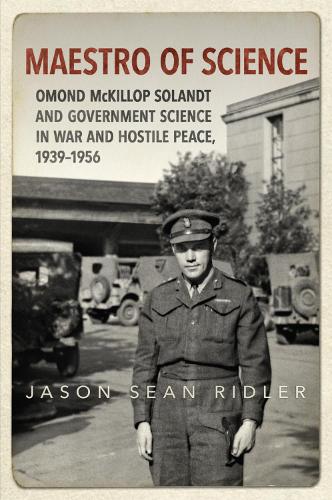
Книга Maestro of Science: Omond McKillop Solandt and Government Science in War and Hostile Peace, 1939-1956
"Maestro of Science is a very considerable achievement, a work of careful and balanced scholarship that documents Solandt's contributions to operational research in the United Kingdom during the war and his post-war government service as Chairman of Canada's Defence Research Board." -- Terry Copp, Director Emeritus, Laurier Centre for Military, Strategic, and Disarmament Studies, Wilfrid Laurier University "Based on prodigious research in government and personal manuscript collections in both Canada and the United Kingdom, Maestro of Science is a worthy contribution to the military, scientific, and institutional history of British and Canadian defence research in World War II and the early Cold War years." -- Richard V. Damms, Department of History, Mississippi State University
One of the brightest Canadian scientists of his generation, Omond McKillop Solandt was a physiologist by training, an engineer by disposition, and a manager by necessity. A protégé of insulin’s co-discoverer, Charles Best, Solandt worked as a scientist for the British government during the Second World War, including as a pioneer of operational research and a manager of scientific establishments. Ending the war as a colonel, he served on the British Mission to Japan, where he studied the effects of the atomic bombs at Hiroshima and Nagasaki, before returning to Canada to become chairman of the newly created Defence Research Board. There he spearheaded Canada’s attempt to create a new and innovative government science infrastructure that served the needs of the Canadian military at the dawn of the nuclear age and worked alongside allies in Britain and the United States.
In Maestro of Science, Jason S. Ridler draws on interviews with Solandt and his colleagues and declassified records from Canada and the United Kingdom to paint a vivid picture of the influence and achievements of a Canadian leader in Cold War military research.
"
‘Ridler provides fascinating insights into a fine grained history – the experiences of a scientist-administrator balancing the demands of research and the political imperatives of the wartime and postwar worlds.’
" - Isis vol 108:01:2017