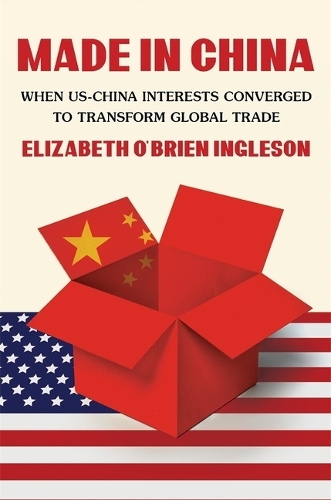
Книга Made in China: When US-China Interests Converged to Transform Global Trade
The surprising story of how Cold War foes found common cause in transforming China’s economy into a source of cheap labor, creating the economic interdependence that characterizes our world today.
For centuries, the vastness of the Chinese market tempted foreign companies in search of customers. But in the 1970s, when the United States and China ended two decades of Cold War isolation, China’s trade relations veered in a very different direction. Elizabeth Ingleson shows how the interests of US business and the Chinese state aligned to reframe the China market: the old dream of plentiful customers gave way to a new vision of low-cost workers by the hundreds of millions. In the process, the world’s largest communist state became an indispensable component of global capitalism.
Drawing on Chinese- and English-language sources, including previously unexplored corporate papers, Ingleson traces this transformation to the actions of Chinese policymakers, US diplomats, maverick entrepreneurs, Chinese American traders, and executives from major US corporations including Boeing, Westinghouse, J. C. Penney, and Chase Manhattan Bank. Long before Walmart and Apple came to China, businesspeople such as Veronica Yhap, Han Fanyu, Suzanne Reynolds, and David Rockefeller instigated a trade revolution with lasting consequences. And while China’s economic reorganization was essential to these connections, Ingleson also highlights an underappreciated but crucial element of the convergence: the US corporate push for deindustrialization and its embrace by politicians.
Reexamining two of the most significant transformations of the 1970s—US-China rapprochement and deindustrialization in the United States—Made in China takes bilateral trade back to its faltering, uncertain beginnings, identifying the tectonic shifts in diplomacy, labor, business, and politics in both countries that laid the foundations of today’s globalized economy.
"Meticulously researched…Rife with interesting and fresh anecdotes, the book takes us through the early days of an unsteady trading relationship trying to find its footing…Ingleson offers keen observations about the differing ways China and the United States incentivized trade during normalization." - Finance & Development
"Ingleson nicely meshes large-scale economic analysis with fine-grained accounts of how businesspeople warily navigated the new world of U.S.-China trade…a revealing overview of a critical sea change in the world economy." - Publishers Weekly
"A beauty. [This book] demonstrates exquisitely detailed research, originality of thought, maturity of judgement and a wide-angled vision of geopolitics…The detailed argument is something any serious student of China and the global economic system should eat up over a weekend…this is a case study in globalisation, the international freeing up of capital markets, the creation of complex value chains and the way in which China boomed and America fractured. It’s thoroughly worth reading on all these levels." - The Australian
"A wonderful book that should be read by every serious student of US-China relations…Beautifully and engagingly written, it is also a book that will give all readers genuine pleasure and enjoyment. It should be a fixture of libraries and syllabi for many years to come." - China Quarterly
"Wow, what a book. Written in academically solid yet lively prose, it is a brilliant examination of how politics transforms trade, and trade transforms politics." - Saturday Paper
"Provides helpful insights into the changes that occurred during this decisive decade. Through extensive archival research, [Ingleson] recounts how various U.S. policy choices during the 1970s helped open the door to globalization, how Chinese government policies sought to exploit that opening for China’s own economic development, and how U.S. businesses facing this new global incentive structure began to rethink their supply chains." - American Affairs
"Rich in anecdotes and personality sketches of the pioneers of Sino-American trade…These are familiar debates to which [this book] makes a spirited contribution, but [Ingleson] brings fresh insight by highlighting ‘a deeply held’ political continuity that ‘persistently framed trade and manufacturing in terms of the nation state’…In the springtime of 2024, when China’s supreme leader Xi Jinping has just summoned the top executives from American business to an audience with him that is meant to reassure them that all will be set fair despite his xenophobia, his ideological commitment to state control, and his Stalinist political instincts, it is worth taking the time to read the case studies laid out in this book." - Engelsberg Ideas
"Ingleson’s sharp and illuminating study introduces key moments and figures in the 1970s transformation of Sino-US trade to explore how changes in US capitalism created the conditions for China’s economic rise. By taking us back to the early, uncertain moments of renewed Sino-US relations, [this book]…provides that shocking jolt that the best histories do, reminding us of things forgotten beneath decades of layered teleological explanations for how we got from there to here." - Los Angeles Review of Books