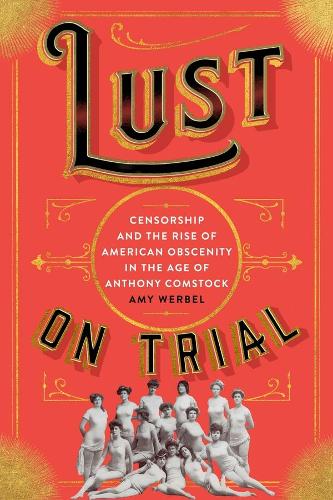
Книга Lust on Trial: Censorship and the Rise of American Obscenity in the Age of Anthony Comstock
Anthony Comstock was America’s first professional censor. From 1873 to 1915, as Secretary of the New York Society for the Suppression of Vice, Comstock led a crusade against lasciviousness, salaciousness, and obscenity that resulted in the confiscation and incineration of more than three million pictures, postcards, and books he judged to be obscene. But as Amy Werbel shows in this rich cultural and social history, Comstock’s campaign to rid America of vice in fact led to greater acceptance of the materials he deemed objectionable, offering a revealing tale about the unintended consequences of censorship.
In Lust on Trial, Werbel presents a colorful journey through Comstock’s career that doubles as a new history of post–Civil War America’s risqué visual and sexual culture. Born into a puritanical New England community, Anthony Comstock moved to New York in 1868 armed with his Christian faith and a burning desire to rid the city of vice. Werbel describes how Comstock’s raids shaped New York City and American culture through his obsession with the prevention of lust by means of censorship, and how his restrictions provided an impetus for the increased circulation and explicitness of “obscene” materials. By opposing women who preached sexual liberation and empowerment, suppressing contraceptives, and restricting artistic expression, Comstock drew the ire of civil liberties advocates, inspiring more open attitudes toward sexual and creative freedom and more sophisticated legal defenses. Drawing on material culture high and low, including numerous examples of the “obscenities” Comstock seized, Lust on Trial provides fresh insights into Comstock’s actions and motivations, the sexual habits of Americans during his era, and the complicated relationship between law and cultural change.
"An incisive history of the futility of censorship ... richly detailed." - Kirkus Reviews
"An insightful and entertaining critical examination of the prominent American censor Anthony Comstock (1844-1915). . . . [a] fascinating, page-turning study." - Publishers Weekly
"A thoughtful new addition to the literature on Comstock and 19th-century sexual mores." - Library Journal
"[A] dense and enjoyable book." - Los Angeles Review of Books
"A richly detailed, deeply researched and lavishly illustrated account of Comstock’s career and legacy." - Times Literary Supplement
"Making good use of recent monographic studies of mass media and the history of sexuality, the author, an associate professor of the history of art at the Fashion Institute of Technology, places the architect and chief executor of U.S. anti-obscenity law in a thick social and cultural context." - Inside Higher Education
"A work more relevant now than ever . . . [A] titillating manuscript." - The Gotham Center for New York City History
"Meticulously researched study." - Panorama
"Intensely researched and thought-provoking work." - Journal of Intellectual Freedom and Privacy
"Amy Werbel’s new study turns up other surprises that will make the work of interest to students of art
history as well as readers with an interest in gender and LGBTQ history." - American Historical Review
"A visually striking book. . . . Historians will appreciate Werbel’s attention to uncovering the stories of everyday Americans who found themselves in Comstock’s crosshairs, and her book will make a lively addition to undergraduate and graduate courses on the histories of art, obscenity, and sexuality." - H-SHGAPE
"Werbel’s book is well worth reading; it adds to our understanding of the transformation of American culture in the early decades of the twentieth century." - Winterthur Portfolio